
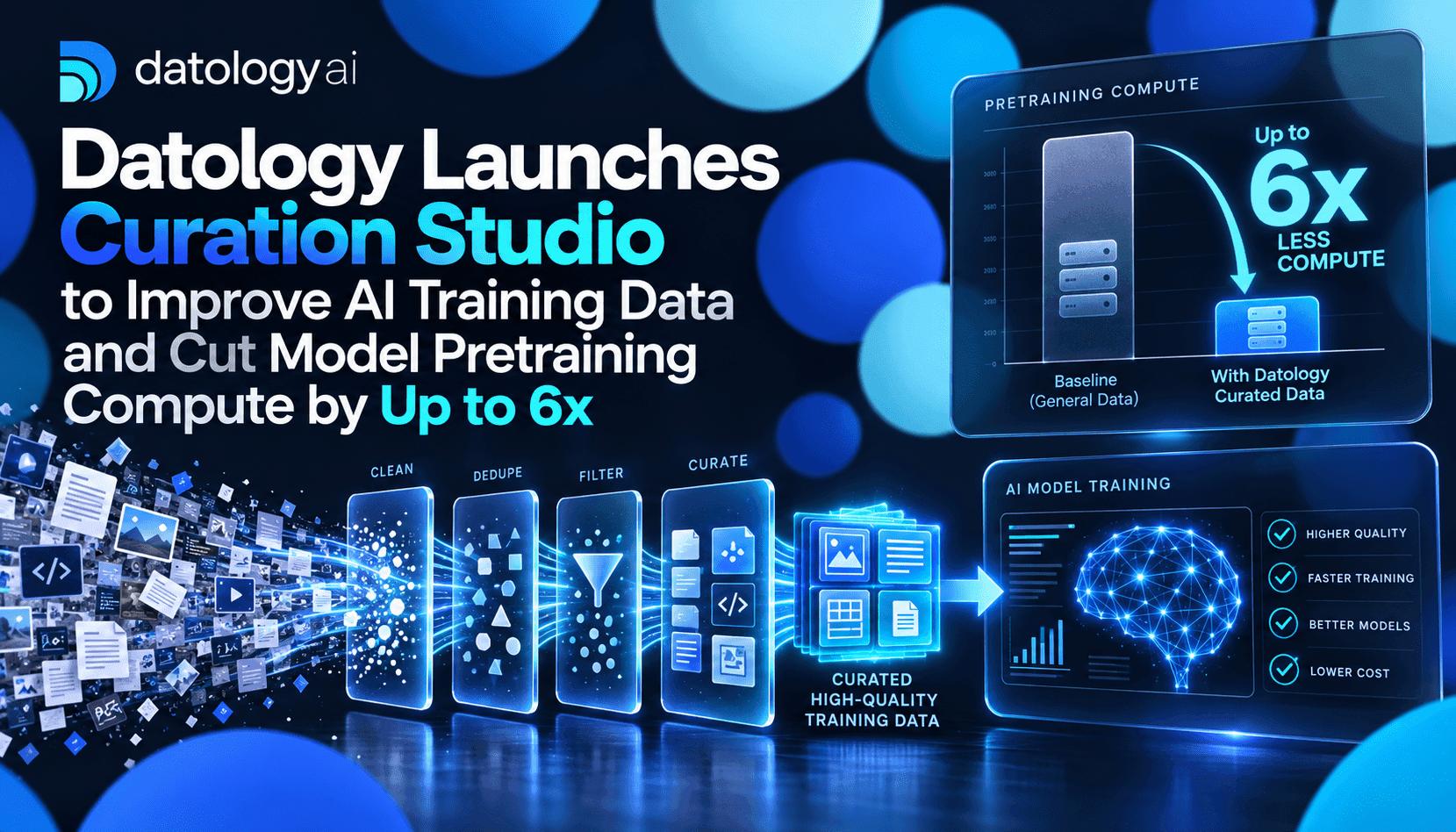
Datology’s new Curation Studio is positioned as an operational layer between raw content and model training. Instead of simply ingesting ever-larger token counts, the product applies a four-stage pipeline — clean, calibrate, create, compose — to surface the highest-value signal for the tasks you care about. That approach matters because Datology’s experiments show that a model’s effective performance can be amplified far more efficiently by curating training data than by blindly increasing pretraining compute. For engineering and product teams, that shifts where attention and budget should flow: from raw GPU-hours to data lifecycle engineering and synthetic augmentation strategies.
The technical core is familiar in principle but scaled in execution: rigorous decontamination and heuristic cleaning, per-document scoring and reweighting, synthetic generation grounded in high-quality source examples, and a configurable composition engine that mixes subsets for different training stages. Datology claims they ran experiments where curated datasets led smaller models trained on fewer tokens to match or exceed larger baselines trained on substantially more compute. For practitioners, the immediate implication is practical — you can trade pretraining FLOPs for smarter curation workflows and smaller serving models that cost less at inference.
Operationalizing frontier curation at enterprise scale brings nontrivial engineering demands. Datology reports petabyte-scale pipelines, custom operator graphs, and extensive intermediary caching to run hundreds of terabytes to petabytes of processing without exploding costs or runtime. That work is the difference between laboratory research and a product teams can run inside a customer VPC. For companies weighing proprietary model builds, this product model matters: you retain data control, maintain provenance, and avoid sending raw IP to external services while still benefiting from advanced curation techniques.
The business case centers on two measurable outcomes: model performance per pretraining compute and inference cost per task. Datology’s examples — where a curated 12B model pretrained on fewer tokens beat a larger 30B baseline that used far more compute — illustrate how curation can reduce both the size and the training budget of effective production models. For decision-makers, the takeaway is concrete: invest in data tooling and pipelines early, and design experiments that measure performance against compute-normalized baselines rather than token counts alone.