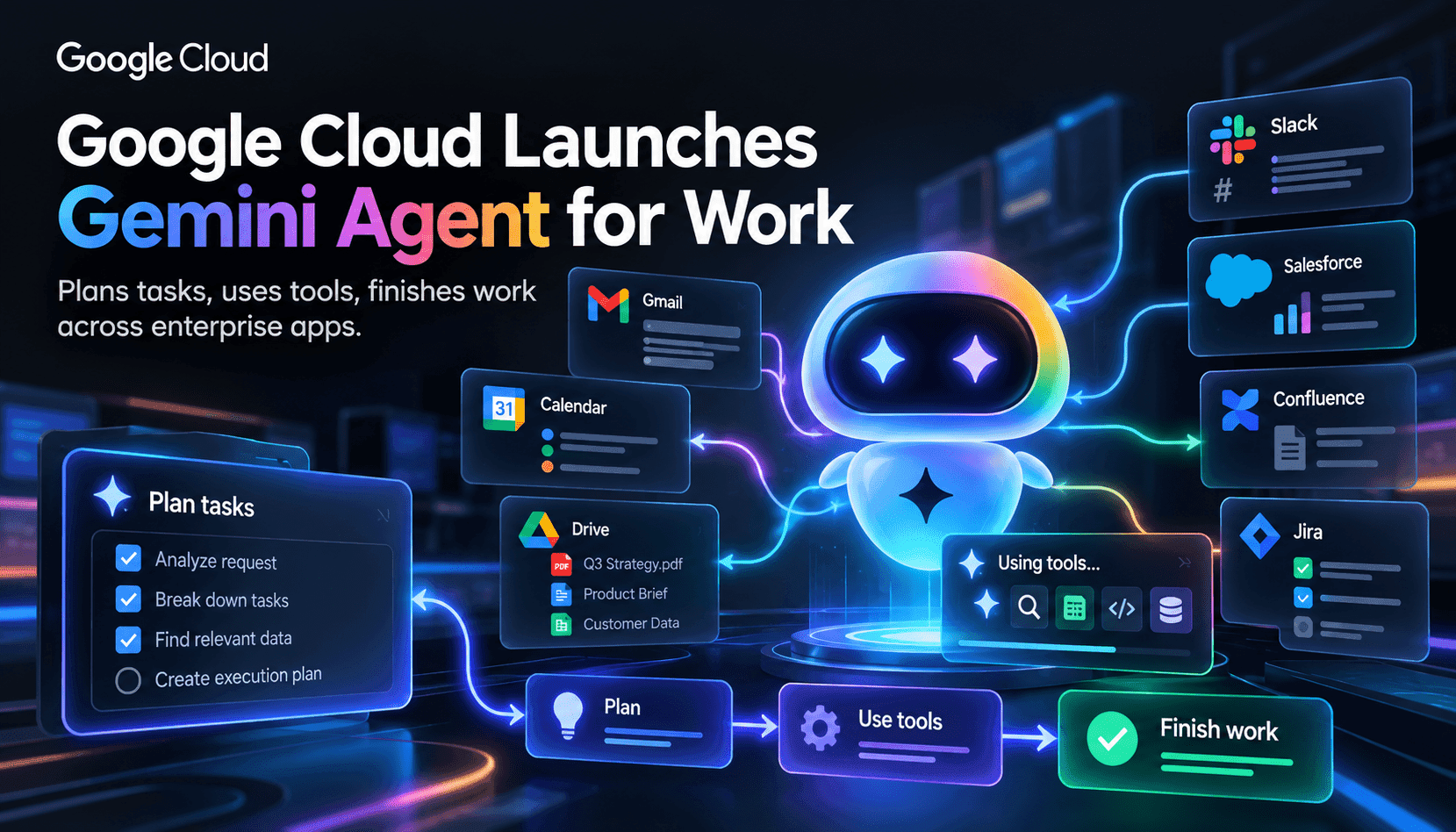
Google Cloud’s Gemini Agent aims to be a single enterprise work agent that plans multi-step tasks, invokes tools and skills, connects to business systems, and returns finished work into documents, inboxes and IDEs. This analysis explains how built-in model selection, cost controls and governance set it apart from standalone chatbots.
Google Cloud’s Gemini Agent is an architectural move: instead of releasing another conversational endpoint, Google has launched an agent designed to be the single work orchestrator inside an enterprise. The selling point is not novelty in natural language alone but the ability to plan multi-step work, call specialized skills and tools, and return finished outputs directly where people already do work — documents, inboxes and IDEs. For decision-makers this reframes the integration question: is Gemini a feature to bolt on or the agent layer you adopt centrally?
Operationally, Gemini’s value proposition breaks into three coordinated capabilities: context-aware planning, tool and skill invocation, and finished-work delivery. Context-aware planning means the agent can use organization data — permissions, process templates, CRM context — to sequence tasks rather than only answer a single prompt. Tool invocation lets the agent run connectors, call APIs, or use internal skills to complete subtasks. Finished-work delivery is crucial: this agent returns artifacts into the apps users already use, trimming handoffs and change management friction.
For engineering and platform teams, another headline is model and cost governance built into the agent. Gemini chooses the best model for the job, applies cost controls and exposes admin controls suitable for enterprise SLAs. That implies fewer ad-hoc model endpoints and more consistent observability, but it also concentrates decision-making about acceptable model behavior and spend inside the agent configuration — a trade-off teams must evaluate.
For product and ops leaders the immediate questions are practical: how does Gemini integrate with existing identity and data policies, how do you map skills to business units, and what guardrails stop leaks or incorrect automation? Google’s emphasis on governance and admin controls signals that enterprise readiness was prioritized, but integration complexity and change management remain real adoption barriers. This article breaks down the technical and operational implications and recommends next steps for teams considering Gemini as their enterprise agent layer.
How Gemini plans, invokes tools and returns finished work
Gemini’s core operational model is workflow planning: given a goal, the agent decomposes the work into ordered steps, selects or composes skills, and orchestrates APIs and tools to complete subtasks. That can include data lookups, structured updates in CRMs, document edits, code changes in repos, or multi-recipient email drafts. The practical gain is fewer manual handoffs — the agent can land outputs directly in the target app rather than handing a to-do back to a user.
From a developer perspective, this requires a robust skill and connector model: teams must design deterministic skills, idempotent operations, and clear error-handling paths so the agent can retry or roll back changes safely. The overall architecture blurs lines between RPA, integration middleware, and conversational AI, creating both efficiency opportunities and architectural responsibility for platform teams.
Built-in model selection, cost controls and governance
A central differentiator is Gemini’s promise to pick the right model for the task and apply cost controls at the agent layer. That reduces ad-hoc decisions about which model to call for a job and enables centralized monitoring of spend, latency and accuracy. For enterprises that have struggled with runaway model costs across multiple teams, this is a practical lever to tame consumption while aligning model capability to task sensitivity.
Governance features — admin roles, provenance tracking, policy enforcement, and enterprise-grade security — are emphasized. In practice, teams will need to validate whether those controls integrate with existing IAM, data loss prevention, and audit tooling, and whether policy granularity is fine enough to allow differing rules across teams and data types.
Integration patterns and where Gemini fits in workflows
Gemini is engineered to deliver outputs into documents, inboxes and developer environments, which means the most straightforward adoption patterns start with augmenting existing apps rather than replacing them. Use cases that map well include automated meeting summarization and action completion, sales workflow orchestration that writes CRM entries and outreach, and developer assistance that makes code edits or generates PRs in context.
Enterprises should pilot Gemini for one bounded workflow, instrument observability, and measure end-to-end value (time saved, error reduction, conversion improvement). Integration risks — connector reliability, permission mapping, and skill robustness — need to be surfaced early and paired with rollback strategies and human‑in‑the‑loop checkpoints for high-risk automations.
Risks, limitations and an adoption checklist
Centralizing work orchestration in a single agent brings benefits and concentration risks. If the agent misconfigures permissions or executes flawed skills at scale, the blast radius is larger than a handful of isolated automations. Data residency, access controls, and proven rollback mechanisms are non‑negotiable. Teams must also account for model failure modes, hallucination risk, and the operational cost of maintaining skills and connectors.
Adoption checklist: map high‑value, low‑risk workflows to pilot; define success metrics and observability; bake in human review for critical outputs; test identity and data controls thoroughly; and build a cost model that ties agent activity to business value. Treat the agent as platform infrastructure that requires SRE-like ownership, not a one-off feature.