

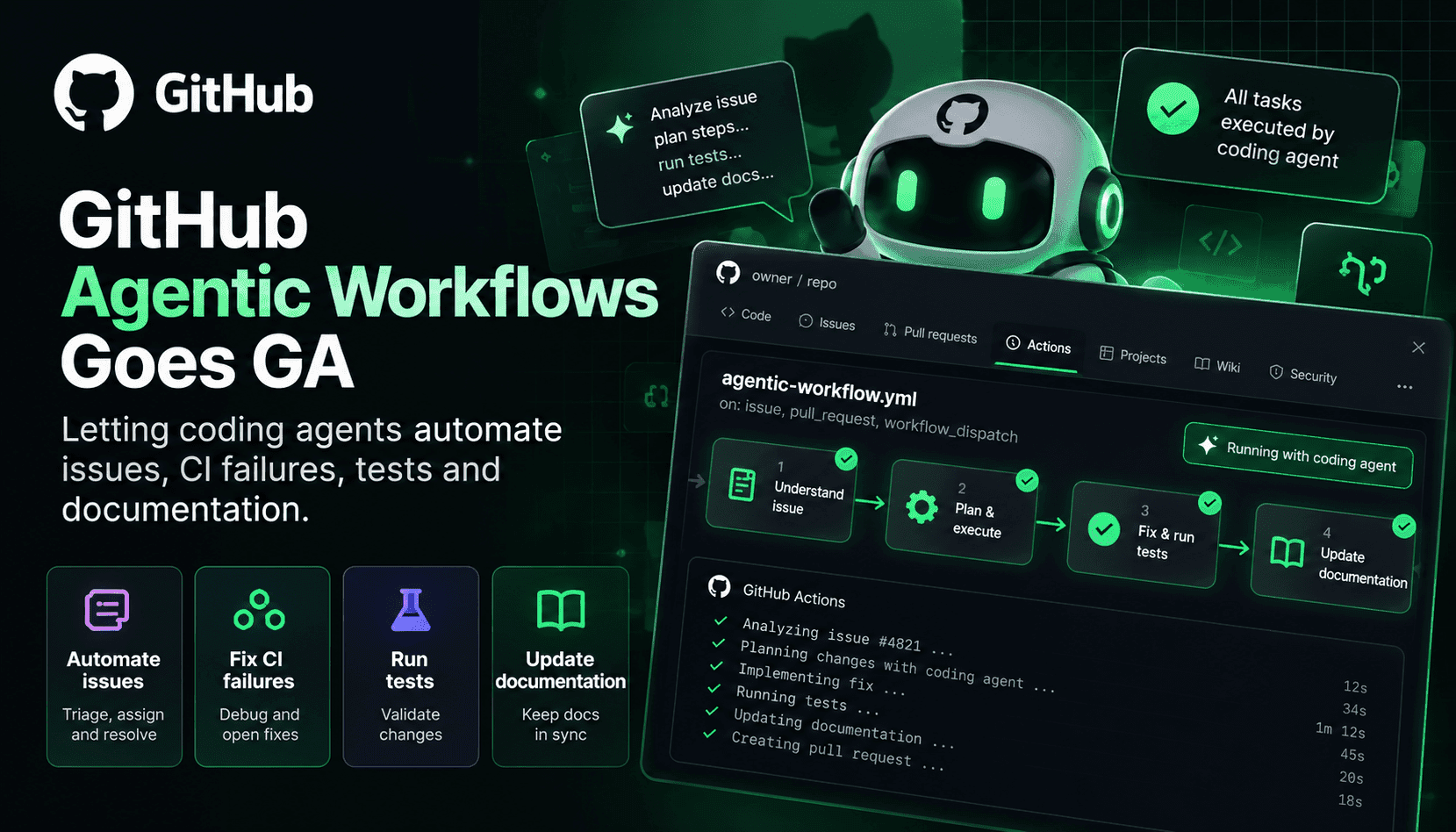
GitHub’s Agentic Workflows GA turns plain Markdown into executable automation: teams write intent and constraints in natural language, and the toolchain compiles those descriptions to standard Actions YAML that invoke coding agents. The key product shift is not just bringing agents into Actions, but making that process repeatable, auditable, and pluggable into existing runner groups and policy controls. For platform engineers, that means you can prototype an agentic policy for issue triage or CI analysis on a self‑hosted runner, pick a model provider or use Copilot, and keep the execution environment consistent with your normal CI/CD footprint.
Practically, agentic workflows change who and how routine repository work is done. Instead of one engineer manually triaging hundreds of incoming bug reports, a workflow can run a coding agent to classify, prioritize, and even propose reproductions or labels in a draft PR. For CI failures, agents can isolate the flaky test, reproduce the failure locally in a Docker‑in‑Docker runner, annotate the failing commit with a suspected root cause, and create a remediation task. When wired to test generators and documentation updaters, those same flows can supply code examples, scaffolding tests, or generate changelog entries automatically—reducing context switches and accelerating time to resolution.
Adopting agentic workflows requires new operational disciplines. GitHub layers several safeguards—read‑only default permissions, a sandboxed execution container behind an Agent Workflow Firewall, safe outputs validation, and a threat‑detection scan for proposed changes. Teams must still define clear integrity filters, allowlists for repositories and secrets, and model routing policies that direct sensitive tasks to more trusted engines. The most effective deployments treat agentic flows like any automation: version them, peer‑review the Markdown intent, and add billing and credit forecasts to avoid surprises from runaway agent cycles.
The ROI case is tangible but nuanced. GitHub cites internal teams that saw doubled velocity and large time savings when agents handled routine steps end‑to‑end. That outcome is achievable when teams invest in templates, validate outputs with CI gates, and monitor quality metrics like false positive triage rates, PR churn from auto‑patched fixes, and test‑coverage delta from generated tests. Conversely, unchecked agent autonomy can increase noise and create maintenance debt, so a staged rollout—starting with read‑only analysis jobs and progressing to PR creation with human review—is a pragmatic path.