

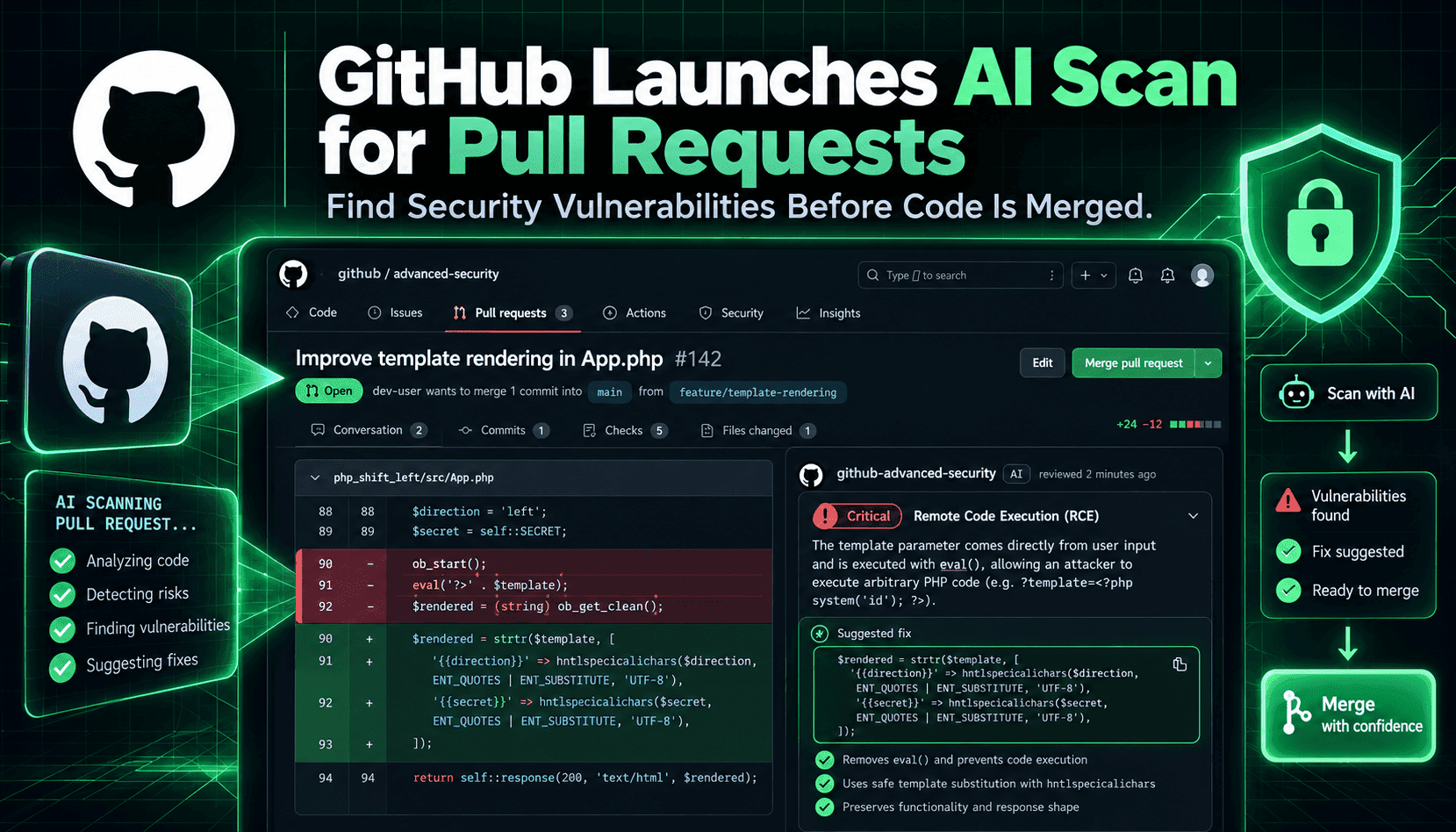
GitHub’s announcement that AI Scan for pull requests is generally available marks a notable shift in how code security can be integrated into daily development flows. Rather than replacing CodeQL’s deterministic pattern-matching, AI Scan applies purpose-built models to the specific context of a pull request: the changed lines, surrounding code, and the repository’s structure. That contextual view allows it to propose findings and even suggested autofixes in languages and files CodeQL doesn’t yet cover, such as PHP, Shell, Terraform HCL, Dockerfiles, JSP and Blazor. For teams shipping fast, this combination promises earlier detection of missing sanity checks, insecure defaults, or deployment-time misconfigurations that static rules alone can miss.
Operationally, AI Scan runs when code scanning and the repository’s AI Scan setting are enabled and surfaces its results alongside CodeQL on the Conversation and Files changed tabs, clearly marked with an “AI” indicator. Importantly, findings are advisory: they don’t fail the code scanning check and cannot block merges via rulesets. That design signals GitHub’s intent to accelerate feedback without imposing hard gates while leaving the final judgement to developers. For organizations, that raises design questions: how to integrate advisory AI findings into triage, when to require human sign-off, and how to reconcile AI-generated autofixes with existing CI/CD and security policies.
From a technical standpoint, AI-assisted scanning differs from traditional static analysis in three practical ways. First, models can synthesize context across files and infer intent from code patterns and comments rather than relying solely on syntactic rules. Second, they can propose pragmatic remediation steps—autofixes—that are code-aware but probabilistic. Third, they can cover languages and configuration formats that lack mature query libraries. Those strengths also introduce distinct failure modes: hallucinated fixes, missed edge cases, or overbroad claims. That’s why verification and repeatable human-in-the-loop workflows are essential before treating AI findings as authoritative.
Practically speaking, teams should treat AI Scan as a new signal in a layered security strategy. Use it to catch likely issues earlier, enrich PR conversation with explanations, and speed triage for noisy, low-risk issues with automated dismissal rules. For high-risk findings—authentication, authorization, cryptography, injective paths—require human confirmation and cross-checks with CodeQL, SAST tools, and pull-request tests. Instrumentation matters: record AI Credit usage, maintain audit trails for autofixes, and track false positives so model behavior can be tuned or scope-constrained by repo-level settings.