

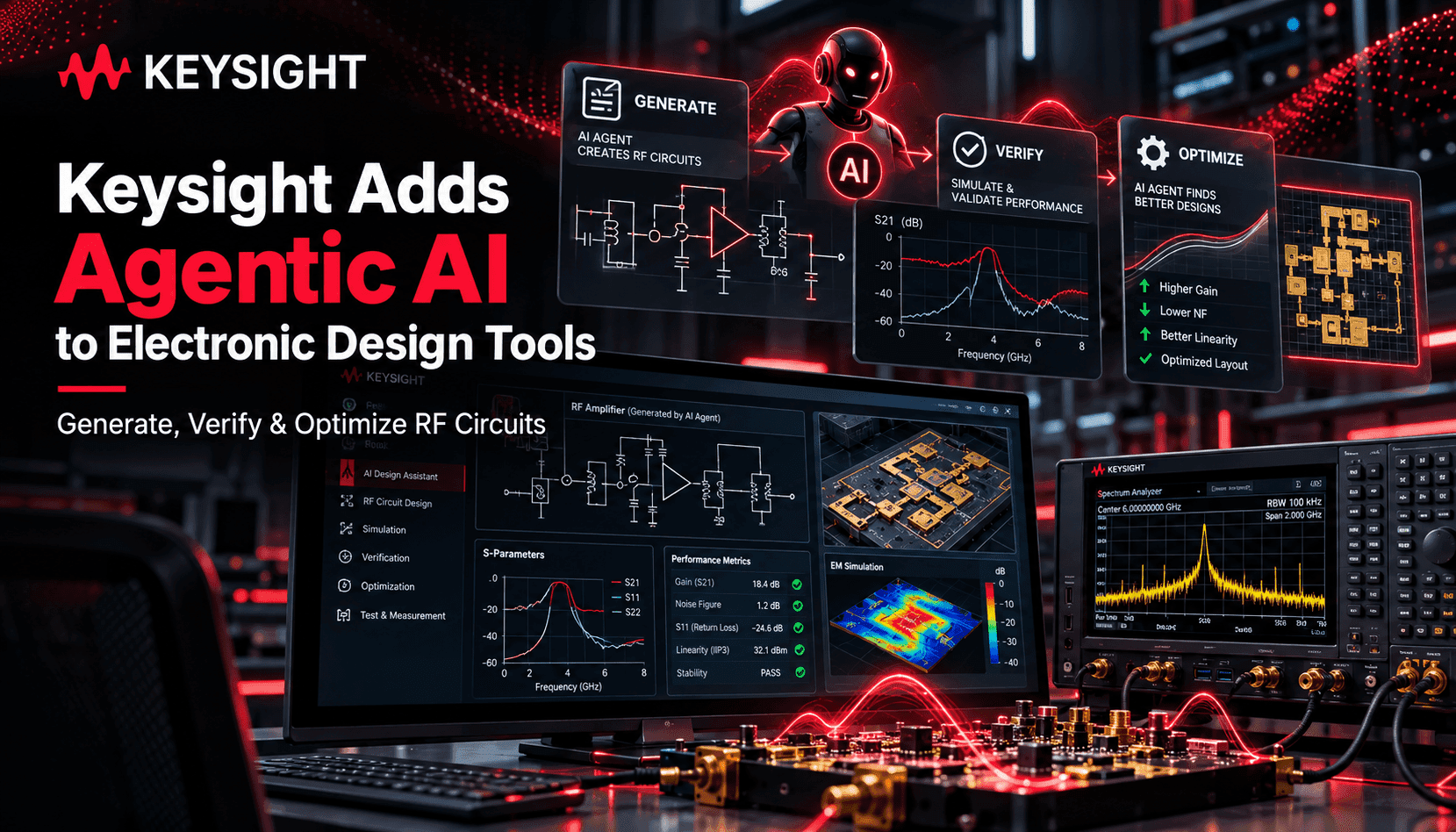
Keysight’s move to connect agentic AI directly to RF design and simulation tools represents a material extension of where autonomous agents operate. Instead of limiting agents to file editing or code generation, these agents will interface with professional measurement and modelling software: instantiating components, running S-parameter simulations, extracting performance metrics and using those results to change designs. That operational connection matters because RF design is a domain with complex trade-offs — noise, nonlinearity, impedance matching and thermal effects — where iterative simulation cycles are heavy and expert knowledge has traditionally constrained exploration.
Practically speaking, agentic integration speeds exploration. An agent can sample thousands of topologies, evaluate return loss and gain curves, and pursue multi-objective optimizations overnight. For startups and systems teams, this shortens the time between concept and verified prototype and creates a new feedback loop where simulation results directly inform agent policy updates. That reduces manual scripting and brittle automation pipelines but also shifts the gating function from human intuition to agent-driven evaluation criteria.
However, moving agents into specialist EDA workflows raises governance and trust challenges. Verification in RF — particularly for regulated or safety-critical radios — requires traceable test procedures, margin analysis and reproducibility of measurements. Teams will need to instrument agent decisions, capture the simulation and measurement provenance, and define acceptance thresholds. Without this, an agent’s optimized design may perform well in a simulated environment but fail under lab conditions or in manufacturing due to mismodelled parasitics, component tolerances or measurement artefacts.
From a commercial angle, Keysight’s approach signals how vendors can expand enterprise value propositions: the company can sell not only instruments and software licenses but workflows and agent orchestration that accelerate product cycles. For buyers evaluating this technology, the immediate questions are integration friction with legacy workflows, licensing and auditability. Firms that adopt agentic EDA first will likely see competitive time-to-market advantages, while laggards face higher retooling costs to catch up.