

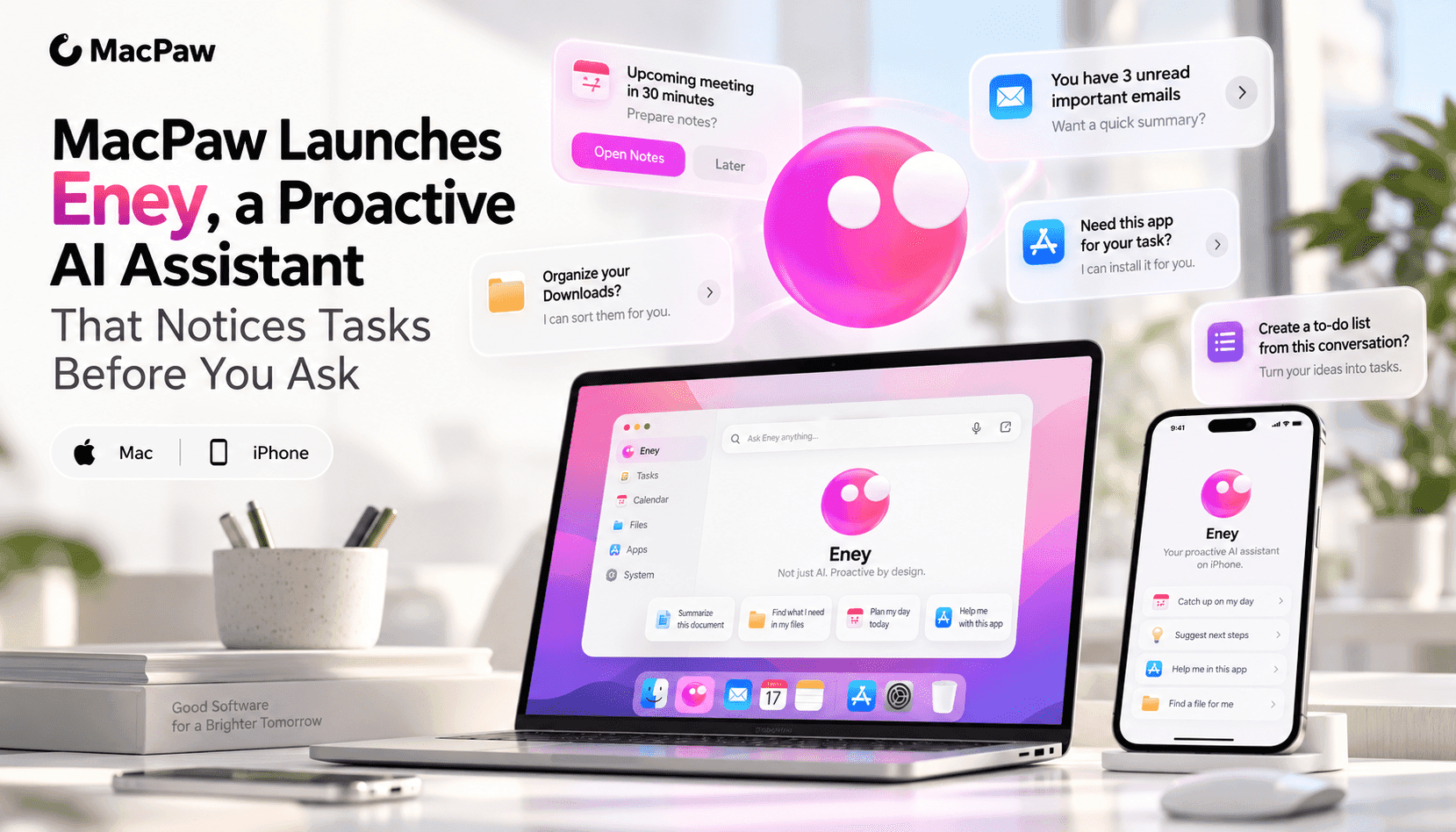
Eney is not a chatbot re-skinned for macOS; it’s a context-first assistant that lives on the machine and on iPhone. Instead of waiting for typed prompts, Eney monitors signals—calendar events, a call starting, copied text, disk pressure—and surfaces suggested actions ready for user approval. That design flips two trends at once: it embraces proactive assistance while explicitly rejecting full autonomy by default. For users who have tried background agents and found them either noisy or untrustworthy, Eney’s “prepare-and-prompt” model offers a middle path: helpful and timely without taking sensitive actions without consent.
Technically, Eney combines local context awareness with selective cloud connectors. MacPaw’s Mnemos memory layer stores only the assistant’s internal facts and provenance signals; the product then connects to Mail, Calendar, Reminders and third-party services like Gmail, Slack, Notion and Drive when users grant access. That hybrid lets Eney draft meeting recaps, generate follow-ups, and clean up downloads while indicating which suggestion relies on which source. For teams and power users the practical result is fewer app switches and a clearer audit trail for every assistant suggestion—important groundwork for trust and incremental automation.
In everyday workflows the assistant’s value shows in concrete micro-savings: transcribe-and-summarize a call, convert copied numbers without opening a calculator, turn highlighted text into a calendar event, or flag a disk filling up and propose a targeted cleanup. Those are the moments where having contextual awareness and a single interface actually beats a string of specialized tools. But the payoff depends on signal quality—accurate calendar parsing, reliable transcription, and connectors that don’t lose metadata—so setup and permission granularity matter more than a glossy demo.
Eney’s safety posture is straightforward: it notices, prepares, and asks. By default Eney does not send messages, change events, or move files without user confirmation, and users can tune how much the assistant can do autonomously. That reduces the risk of unsafe automated side effects and addresses the adoption blockers many agents face today. Still, any system that links local data with cloud services introduces complex trust and compliance questions; enterprises and privacy-aware individuals will want clear controls for connector consent, local versus cloud processing, and memory retention policies.