

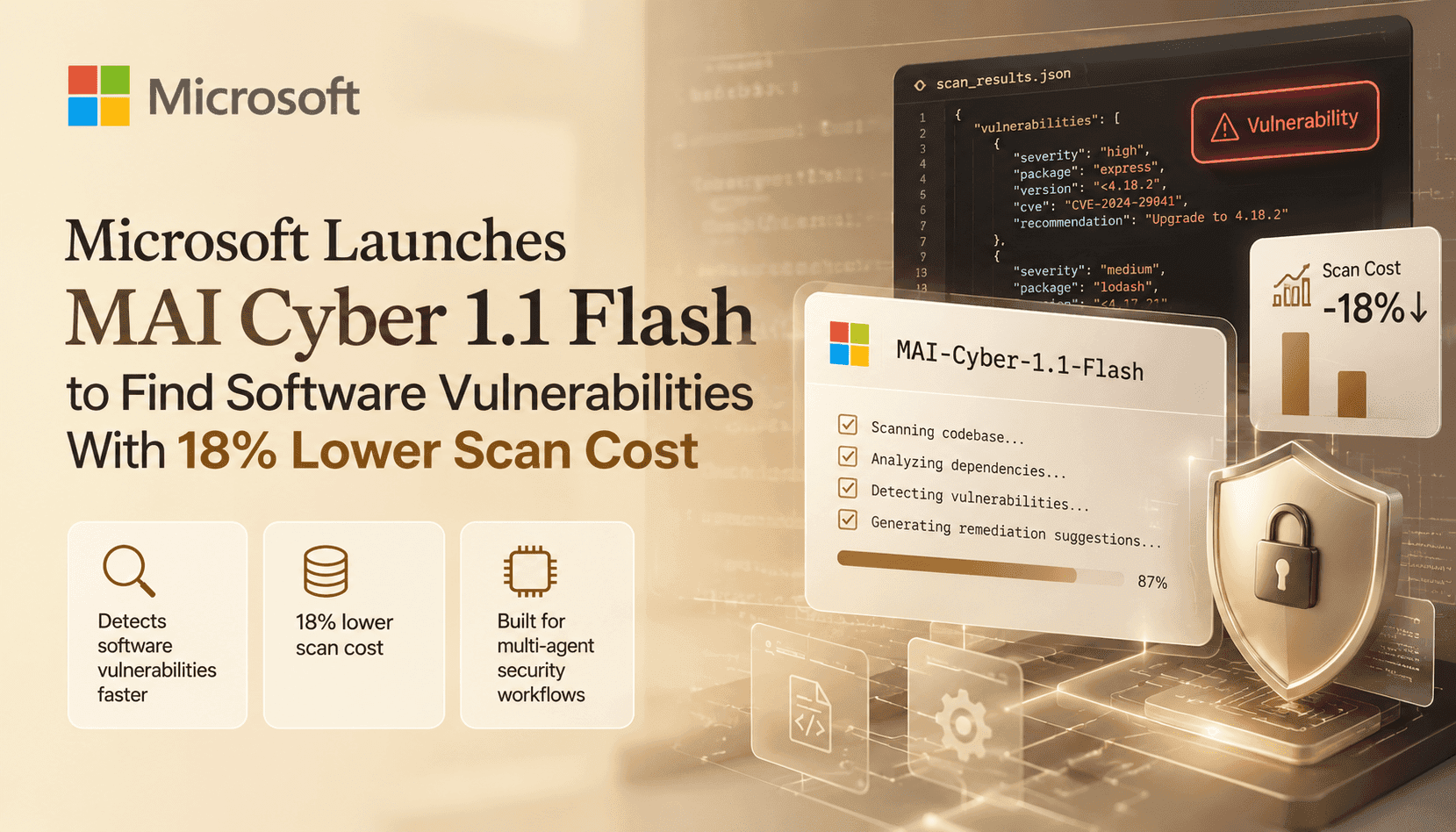
Microsoft’s MAI Cyber 1.1 Flash ships as a purpose-built model inside MDASH, a multi-agent pipeline that coordinates scanning, triage, and suggested remediations. The headline — an 18% reduction in token consumption for similar detection rates — is operationally meaningful because scanning large codebases repeatedly amplifies marginal token costs. But token savings only tell part of the story. For security teams, the real metric is cost per verified vulnerability: how often automated findings are true positives, how much human time they consume to validate, and how quickly they move to remediation.
Specialized models like MAI Cyber 1.1 Flash can outperform general-purpose frontier LLMs on repetitive audit tasks because they compress domain knowledge and exploit predictable patterns in code and vulnerability signatures. During scanning workflows, smaller, cheaper models can run more passes, embed deterministic heuristics, and be tuned to produce structured outputs that reduce downstream parsing work. That doesn’t mean frontier models are irrelevant — they still help with ambiguous cases, exploit chaining, or natural language summarization — but for bulk discovery the cost-benefit favors specialized architectures and pipeline-aware design.
Teams evaluating MAI Cyber 1.1 Flash should instrument experiments that go beyond raw tokens and nominal accuracy. Key comparisons must include: precision at top-k findings, false-positive rate per scan, human validation minutes per finding, and time-to-remediation. One practical exercise is A/B scanning: run MDASH with MAI Cyber 1.1 Flash on a representative code corpus while running an older model or a frontier LLM in parallel, then compare validated vulnerabilities and the cumulative human hours needed to verify them. That yields a real cost-per-action metric managers can budget against.
Finally, automated vulnerability outputs remain inputs, not replacements, for engineering processes. Findings need triage, reproducible testcases, CVE mapping where relevant, and prioritized remediation plans. Integrations — ticketing systems, CI gates, and risk scoring — determine whether token savings translate into reduced mean time to patch. Security leaders should also audit for coverage gaps: specialized models may miss cross-file logic bugs or novel exploit patterns that benefit from larger-context reasoning or targeted adversarial fuzzing.