

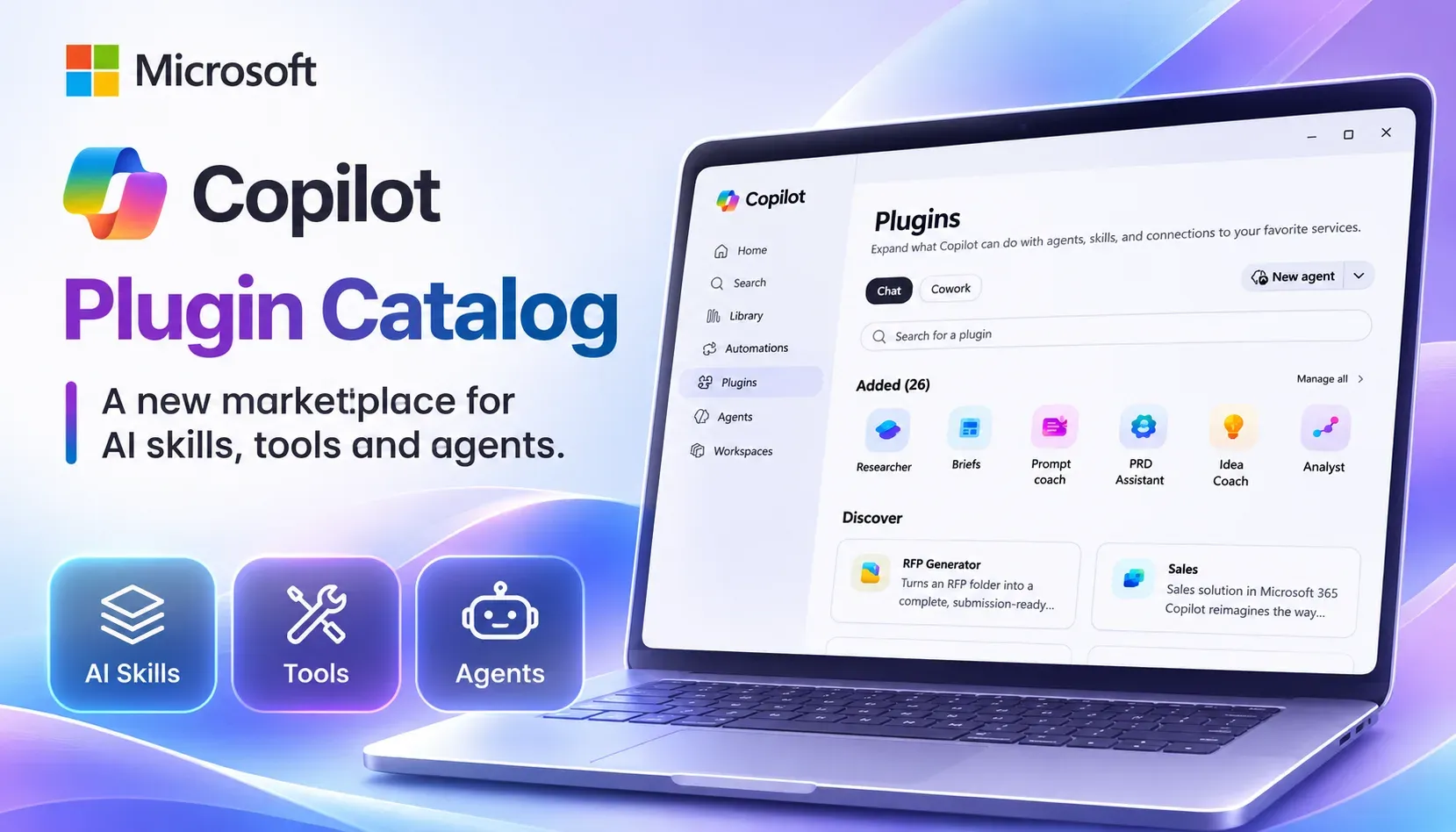
Microsoft is making the Copilot extensibility ecosystem publicly browsable with a Plugin Catalog that goes live at Ignite on Nov 17, 2026. The catalog is intended as a single discovery surface for capabilities that extend Copilot across chat, cowork and integrated app experiences. For end users it will make useful skills, connectors and agent workflows easier to find; for IT teams the plugin registry and catalog together promise consistent governance and lifecycle controls without backend changes. The launch signals that Microsoft is formalizing plugins as first-order enterprise software artifacts rather than ad-hoc integrations.
At the center of the announcement is an explicit plugin model that separates three primitives: Skills, Tools, and Agents. Skills capture reusable instructions, examples and standards that teach Copilot how to complete a task reliably; Tools connect Copilot to data or actions via defined inputs, outputs and permissions (connectors sit inside this category); and Agents are higher-order orchestrators that reason over goals and call skills and tools to achieve outcomes. That modular taxonomy matters because it shapes how vendors package value and how IT governs what runs against enterprise systems.
Beyond product semantics, the catalog reframes distribution for enterprise AI. Historically enterprise software spread through sales cycles, integrations and marketplaces controlled by vendors or channel partners. A curated, public catalog attached to a major productivity layer like Copilot creates a parallel channel: discoverability inside workflows. That changes GTM for independent software vendors and system integrators, and forces product teams to think about packaging, permission models and trust signals that matter inside a productivity context rather than a standalone app store.