

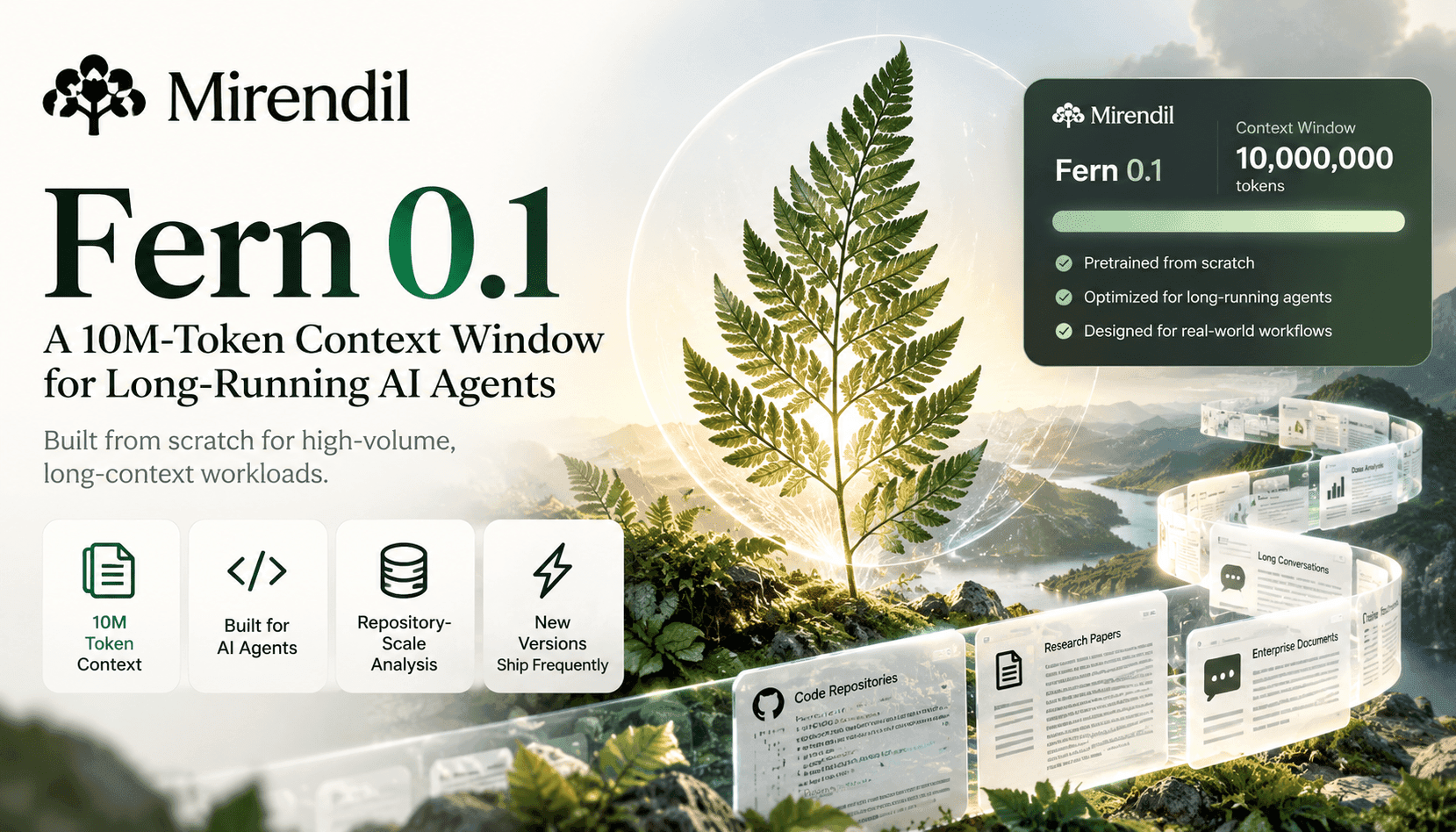
Fern 0.1 is Mirendil’s first foundation model, trained and served with an architecture that supports up to 10 million tokens of context. On paper, that’s a discontinuity: tens of megabytes of code or days of an agent’s interaction history can be held in working context, not shunted to an external store. For teams building long-running autonomous agents, the immediate appeal is straightforward — fewer round trips to external retrieval systems, the ability to reason across an entire repository or training shard at once, and simpler developer mental models when traces and logs remain directly addressable by the model.
But large window size is an enabler, not a guarantee of better outcomes. Effective use of 10M tokens requires model architecture, attention strategies, and retrieval heuristics that meaningfully surface the right context, and it requires serving and cost models that make using huge context practical. Early Mirendil metrics emphasize next-token improvements and basic long-context benchmarks, which is a promising start — yet the critical questions for production teams are how well models recall and reason over distant context, how latency and cost scale, and whether increased context meaningfully reduces error rates in real tasks such as multi-file debugging or training-data auditing.
For enterprise use, the trade-offs are concrete: do you pay for a single extreme-context model instance that can hold a whole repo and traces in memory, or architect a hybrid that pairs a smaller core model with RAG, indexed memory layers, and a verification pipeline? Fern reframes that choice by expanding what’s possible without intermediary retrieval, but teams must still weigh robustness, observability, and edge-case reasoning failures before consolidating on an extreme-context strategy.