

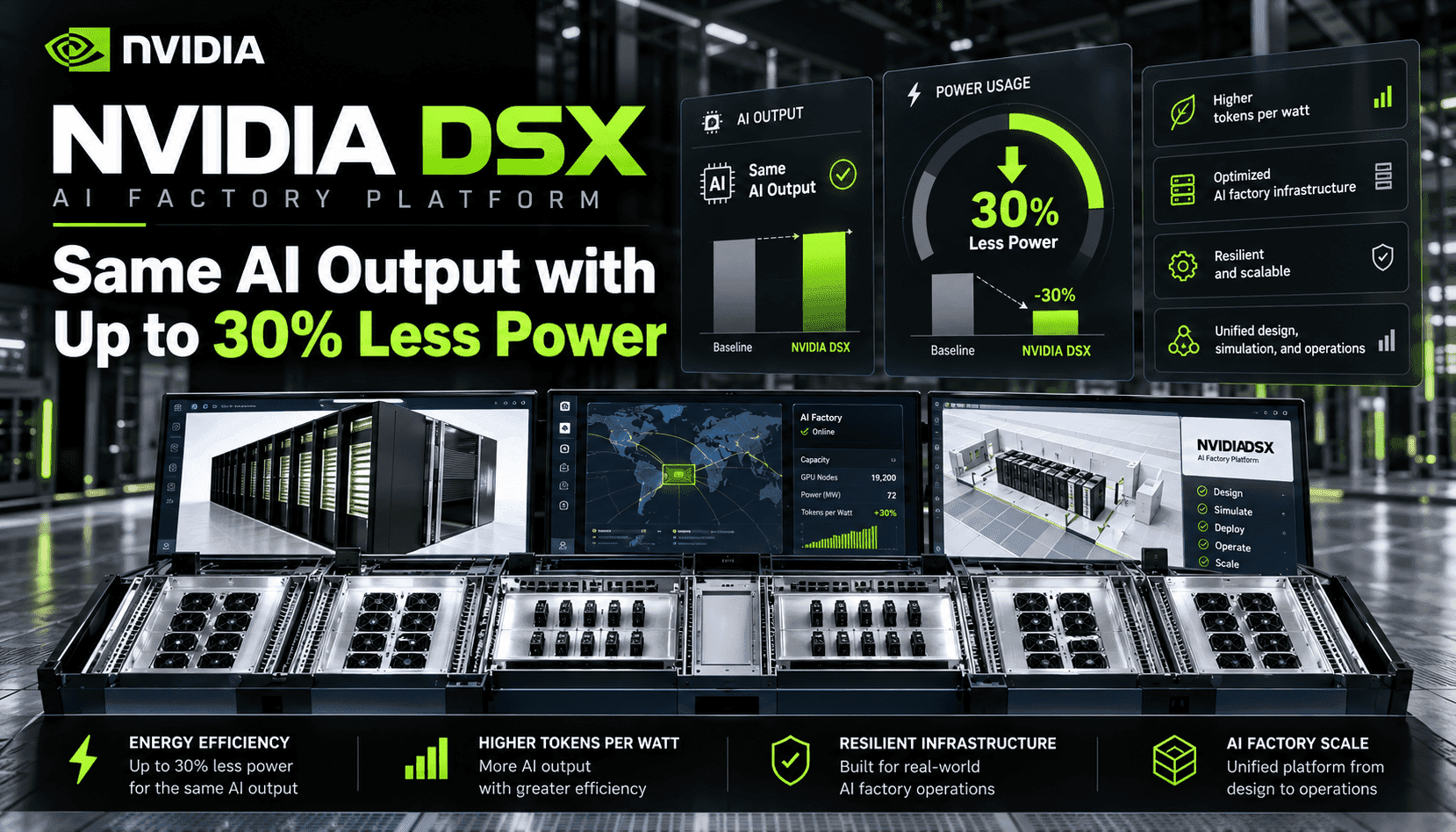
NVIDIA’s DSX AI Factory platform reframes data center efficiency not as incremental rack-level gains but as system co-design across compute, power and cooling. The headline claim—DSX MaxLPS can generate the same number of tokens with up to 30% less power—comes from dynamic power allocation across racks and validated reference architectures that combine liquid-cooled compute with outdoor dry-coolers to limit evaporation. That combination targets two hard constraints for large-scale AI in Europe and other grid- and water-constrained regions: how many megawatts can be connected to a site, and whether local water supplies can sustain traditional evaporative cooling.
The DSX story is practical, not only promotional. Partners running proof-of-concept and early trials report concrete capacity benefits inside fixed power envelopes. Lambda’s HGX B200 cluster tests with MaxLPS showed roughly 24% more cluster token throughput and 19% more GPU capacity within a fixed budget; Nscale’s Iceland evaluation reported 49% higher inference throughput and 37% more managed GPU capacity inside the same 264 kW allocation. Those are operational signals that dynamic power allocation plus system-aware cooling can free headroom without wholesale chip changes.
For operators and planners the metric that matters is shifting: tokens per megawatt, not just GPU flops or per-card benchmarks. Once grid connection and local water limits cap how many racks you can install, the only lever left is extract more usable AI inference and training capacity from each provisioned megawatt. DSX’s software-managed power profiles, combined with validated infrastructure stacks and digital-twin simulation tools, create a new optimization frontier—coordinating workload scheduling, rack power envelopes and facility systems to maximize token output under local constraints.