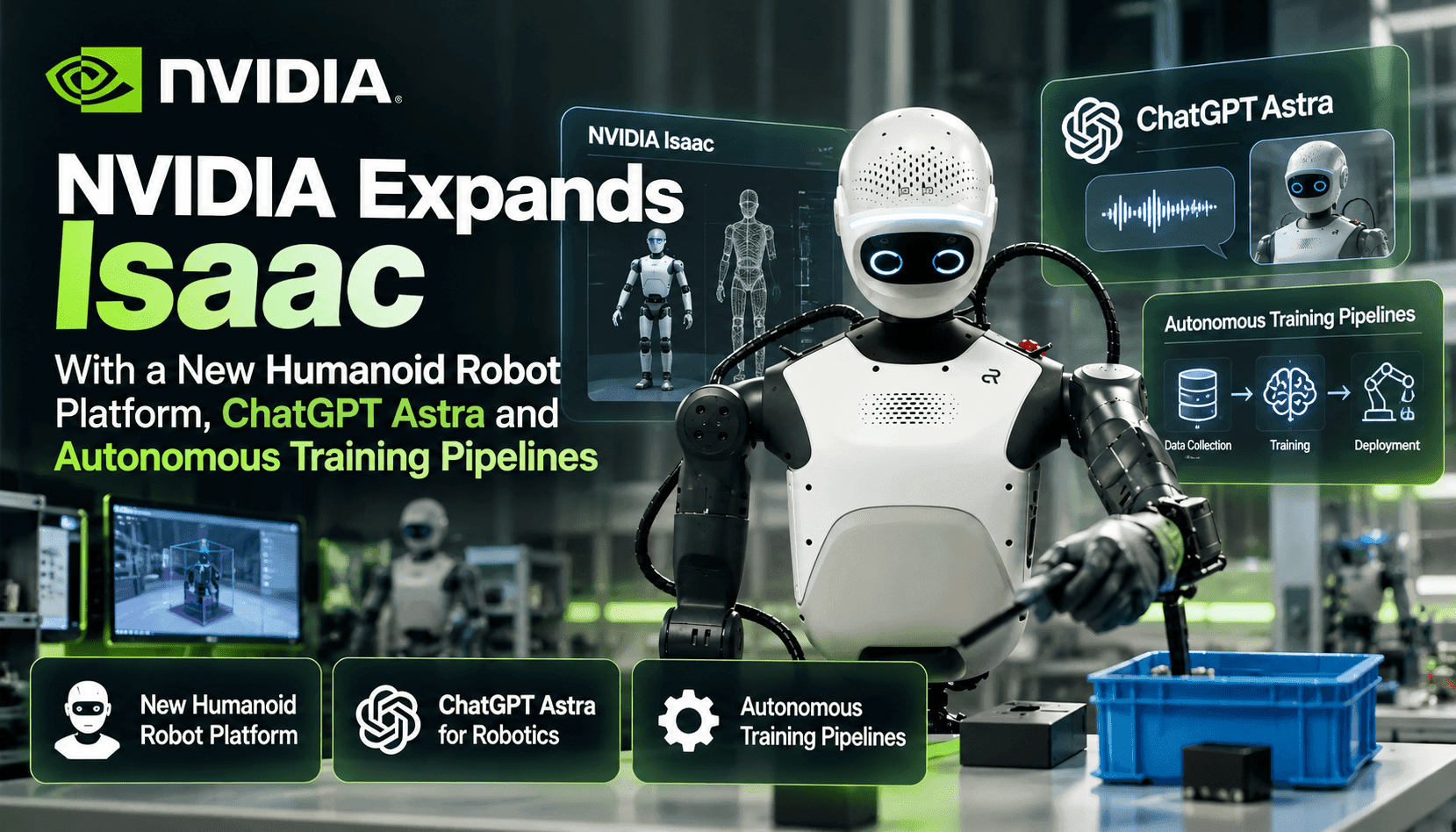
At GTC Berlin NVIDIA revealed a broad expansion of Isaac: a humanoid reference platform, Isaac OS and Isaac Lab 3.0, plus open workflows that link ChatGPT Astra and Cosmos for synthetic data, training and evaluation. This update accelerates simulation-first robot development and reshapes how European integrators and labs take models from reasoning to real-world robots.
NVIDIA’s Isaac expansion at GTC Berlin stitched together several threads the robotics industry has been testing for years: reference hardware, dedicated runtime, richer simulation assets and language-driven synthetic data pipelines. The headline — Agile ONE SN, a 1.4m humanoid preconfigured with Isaac GR00T and Jetson Thor — is a tangible effort to shorten the developer path from simulation to a physical platform. But equally important are the software releases: Isaac OS for deterministic on-robot runtime, Isaac Lab 3.0 for multi-GPU RL workflows, and curated datasets and SimReady assets that make realistic testing and replication faster.
Technically, the update delivers a full-stack play that aligns foundation models, physics engines and safety frameworks. GR00T 1.7 provides a whole-body foundation model for coordinated motion and manipulation; Isaac Lab ties physics engines such as Newton and PhysX into multi-GPU training; and Cosmos supports large-scale world models used to synthesize human interactions. NVIDIA’s workflows explicitly pair ChatGPT Astra for procedural scenario generation with Cosmos for scene synthesis, then train and evaluate policies on DGX Station before transfer, a loop designed to shrink sim-to-real gaps and provide audit trails for policy evaluation.
For European robotics companies and system integrators the news is immediately actionable. ABB, KUKA, Universal Robots, NEURA Robotics, Sereact and others already use Isaac Sim, Omniverse libraries and Isaac Lab in pilots; the new runtime and reference humanoid reduce integration drift between simulation and deployment. The pledges from partners to incorporate Halos safety and IGX/Thor compute into industrial stacks mean pilots can aim for clearer certification pathways. Practically, teams can iterate policies in simulation, run post-training transfer checks with GR00T, and use shared SimReady assets to reduce bespoke asset creation costs.
That said, the promise comes with constraints and risk vectors builders must plan for. High-fidelity simulation still struggles with contact dynamics, tactile sensing realism and corner-case human behavior; safety stacks like Halos mitigate deployment risk but do not replace end-to-end validation and standards compliance. Dependence on NVIDIA’s stack also introduces vendor-lock and concentrated compute costs (DGX, Jetson Thor). For investors and product teams, the rational approach is hybrid: adopt Isaac components to accelerate early development while designing evaluation gates, open-format backups and multi-vendor escape hatches for long-term resilience.
What NVIDIA Announced at GTC Berlin
NVIDIA’s release bundle covers hardware, runtime, datasets and workflows. The marquee items are Agile ONE SN, Isaac OS, Isaac Lab 3.0, SimReady Central Library and three open DGX Station workflows linking ChatGPT Astra, Isaac and Cosmos. These pieces are offered as an integrated route from scenario generation to policy deployment; simulation assets and the Human 1M dataset provide labeled multimodal inputs for perception and behavior models. The updates formalize a simulation-first development cadence that many commercial labs and academic groups had been assembling independently.
Why it matters: developers gain a pre-integrated path that reduces weeks of engineering glue work—covering data capture, training, whole-body control and safety integration—so teams can focus on task-level competence and domain-specific validation instead of building the underlying compute and simulation plumbing from scratch.
How ChatGPT Astra, Cosmos and Isaac Work Together
NVIDIA’s three open DGX Station workflows describe a closed loop: use ChatGPT Astra to generate scenario scripts and human behavior prompts, feed those scripts into Cosmos for photoreal scene and interaction synthesis, then run Isaac Lab multi-GPU RL workflows to refine GR00T-based policies. Post-training evaluation replays synthesized edge cases and metrics are produced for safety review. This chain formalizes a developer flow where reasoning, world-modeling and policy optimization are decoupled but interoperable, accelerating iteration and reproducibility across research and industrial teams.
Implication for practitioners: you can program scenario diversity with LLM prompts, generate large quantities of labeled synthetic data, and run RL or imitation learning at scale without first deploying hardware. That raises expectations for validation tooling — reproducible metrics, deterministic runtime traces and transfer tests must become routine before physical trials.
Agile ONE SN: A Reference Humanoid to Accelerate Research
Agile ONE SN is positioned as a full-stack reference humanoid: 1.4 meters tall, 31 degrees of freedom, dual five-finger hands with tactile sensing, and onboard Jetson Thor compute. Out of the box it combines sensing modalities, whole-body control with Isaac GR00T, and planned integration with Halos for on-robot safety. For research teams this eases the burden of hardware/software integration and gives a common baseline for dexterous manipulation and bimanual coordination experiments.
Practical guidance: labs should evaluate Agile ONE SN as a standardization tool for reproducible benchmarks—not a turnkey production humanoid. Use it to validate models, replicate cross-institution experiments, and establish transfer tests from Isaac Sim to physical behavior before committing to mass deployment designs.
Risks, Limitations and Deployment Advice
High-fidelity simulation reduces early risk but does not eliminate it. Contact-rich manipulation, tactile sensing fidelity, and unpredictable human behavior remain primary sim-to-real failure modes. Additionally, dependence on a single vendor stack concentrates supply-chain and compatibility risk. Teams deploying pilots must design layered validation: synthetic scenario coverage audits, physical gating tests, safety certification engagement (e.g., TÜV SÜD), and contingency plans for compute or software alternatives.
Operational recommendation: define quantitative transfer criteria before hardware trials, budget for compute both at the edge (Jetson Thor) and in data centers (DGX), and insist on reproducible post-training evaluation artifacts to share with partners, auditors and customers.