
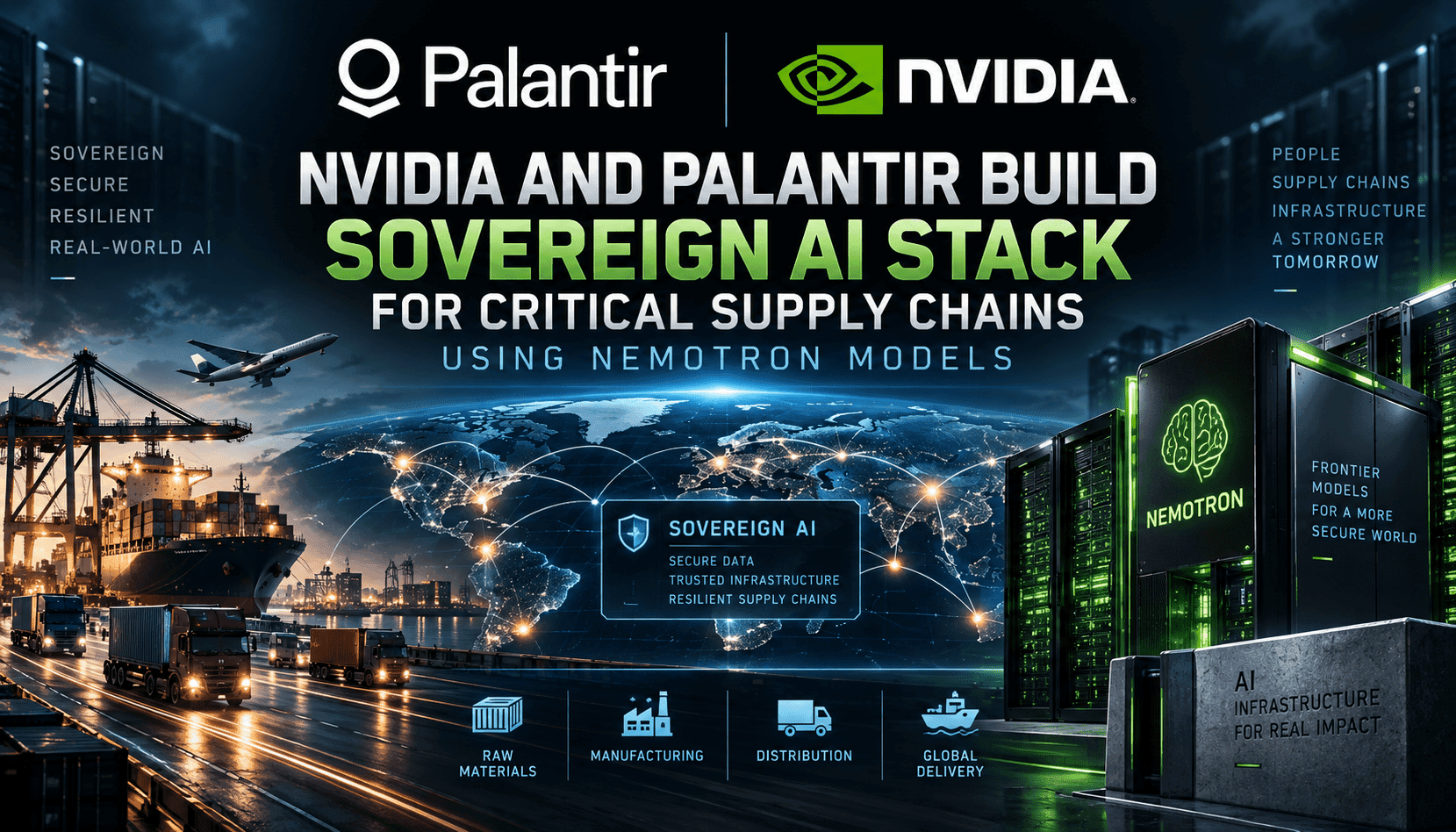
The collaboration pairs Palantir’s Ontology and AIP with NVIDIA’s Nemotron open models to create a supply-chain stack that acts more like an operational brain than an analytics layer. Instead of summarizing backlogs, the system proposes material allocations, sequence changes, and routing options under tight constraints, surfacing tradeoffs in plain language while preserving human oversight. The explicit promise is sovereignty: enterprises keep control of data location, model weights, and deployment patterns, making the stack suitable for regulated, IP-sensitive operations.
Under the hood, post-trained Nemotron models provide reasoning and explanation, while cuOpt runs combinatorial optimization and scenario exploration. Palantir’s Ontology supplies the governed data backbone that fuses part hierarchies, supplier performance, work-in-progress, and capacity states into a single operational graph. NeMo data libraries and AutoModel tooling streamline model adaptation; reinforcement learning loops operationalize feedback so recommendations improve as planners accept, modify, or reject actions. The result is a closed-loop decision system that learns the organization’s playbook rather than replacing it.
Strategically, this is a line in the sand for how enterprise AI will be delivered in high-stakes operations: open, customizable models with documented provenance, deployed on prem, in co-lo, or cloud to meet residency and performance needs. It also signals a shift in buyer expectations—from generic copilots to domain-specific systems with measurable effects on cycle time, service level, and working capital. For tech leaders, the adoption hurdle is less about model accuracy and more about data readiness, control-plane security, and operational guardrails that make machine-speed recommendations safe to trust.