

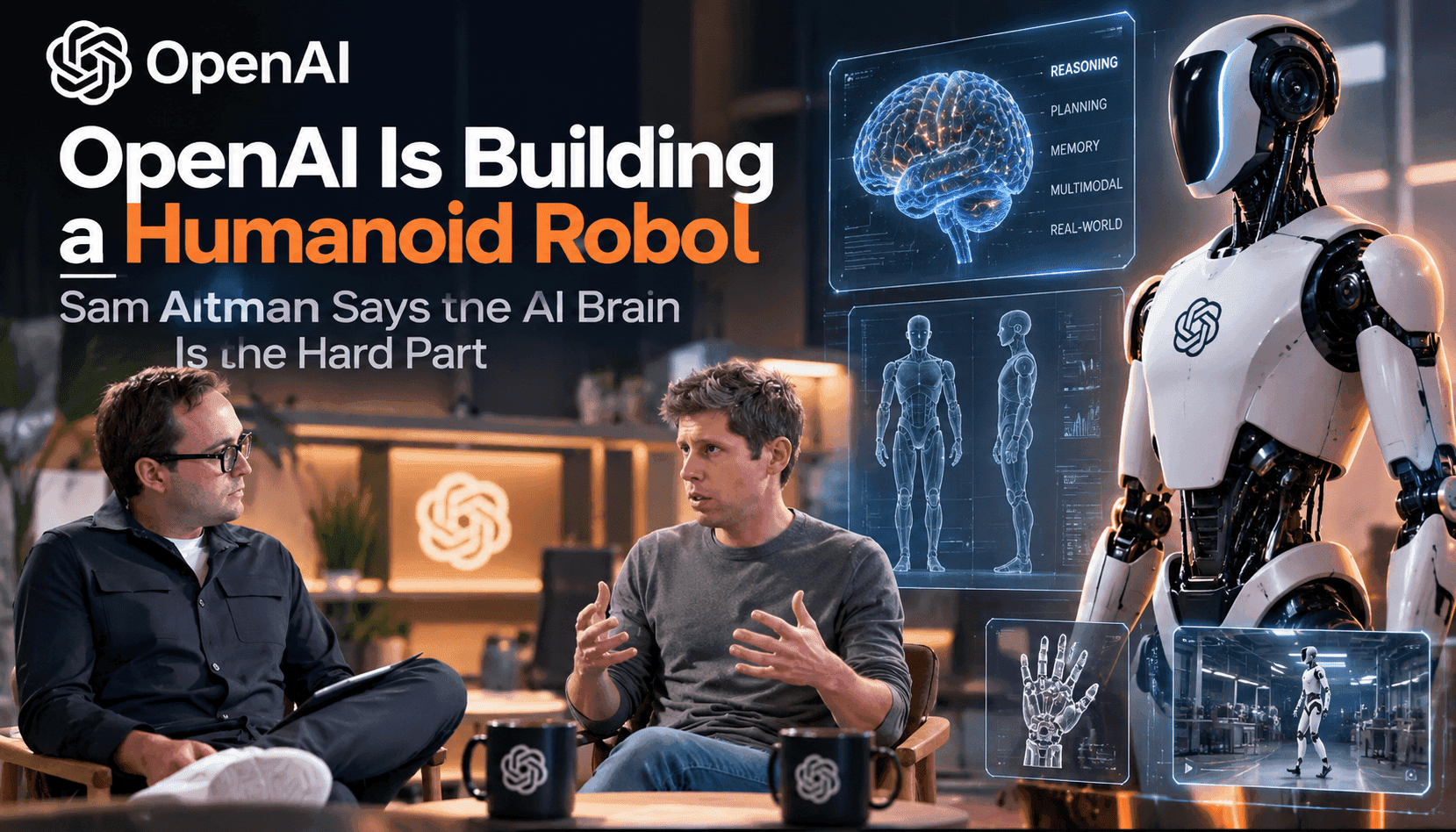
OpenAI's public comments signal a deliberate, brain-forward approach: design a humanoid body where necessary but invest preponderantly in the cognition stack. That distinction matters because modern actuator design, sensing, and mechanical engineering have reached a level where bipedal locomotion and basic manipulation are demonstrably feasible in controlled contexts. The remaining challenge is not hardware alone; it is creating systems that turn raw sensor streams into robust world representations, maintain memory over long tasks, plan across uncertain physics, and execute actions with human-scale reliability and safety. For product leaders and researchers, the implication is clear: differentiating on software and training infrastructure will buy the most leverage.
Perception today uses large multimodal models to fuse vision, depth, tactile proxies and language, but real rooms and workflows still break these models. Current perception pipelines struggle with occlusion, reflective surfaces, sensor noise and small-object localization under distribution shift. That failure cascades: a mistaken object segmentation or pose estimate turns a routine pick into a drop or a collision. Practical engineering requires layered redundancy—sensor fusion, rapid state estimation, self-supervised online calibration—and evaluation across intentionally messy datasets that mirror warehouses, kitchens and construction sites rather than curated lab scenes.
Long-horizon planning and memory are the conceptual center of Altman’s point. Short reflexive controllers suffice for narrow repeated tasks, but general-purpose humanoids must reason through sequences of conditional actions, retain episodic memory about task context, predict the physics consequences of novel manipulations and recover from unmodeled disturbances. Reinforcement learning and model-based world models are promising, but both require sample-efficient transfer from simulation to reality and a composable planning layer that can use symbolic-like abstractions when useful and raw trajectory optimization when necessary.
Safety, verification and human-robot coordination create the highest productization friction. A robot that shares envelopes with people must have provable constraint handling for force, speed and occlusion; transparent intent signaling; and robust fail-safe behaviors. These are not just research problems but deployment blockers that will shape go-to-market choices—limited work domains, co-worker supervision, and tightly instrumented spaces—until confidence in autonomy rises. Investors and operators should budget time and capital for iterative validation in instrumented pilots, not for immediate consumer-grade products.