

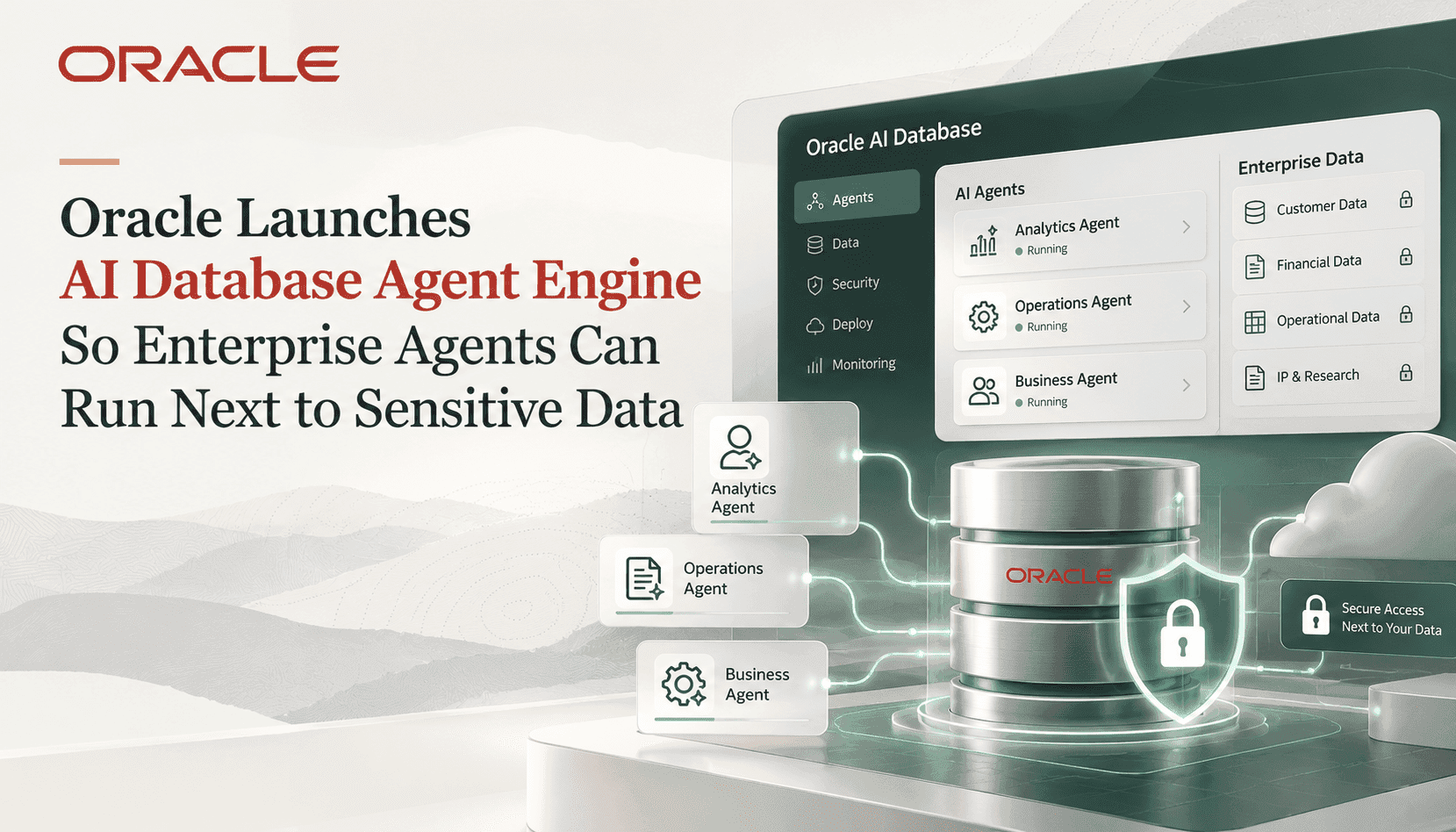
Oracle’s AI Database Agent Engine shifts a core architectural choice: instead of routing sensitive records through an orchestration layer and into external agent platforms, it executes the agent runtime inside Oracle AI Database 26ai. That means declarative workflows—expressed with the Open Agent Specification—run where the data lives. For practitioners, the immediate practical upsides are fewer network round trips, a smaller attack surface for sensitive intermediate results, and the ability to make workflow state transactionally consistent with database operations.
The Engine supports a broad palette of workflow patterns: ReAct-style tool/model interplay, sequential and parallel pipelines, orchestrator and router topologies for branching logic, and loop constructs for iterative processing. Built-in memory keeps workflow context and state alongside the data, and human-in-the-loop gates and auditing are first-class. That combination is aimed at data-centric, latency-sensitive workloads—invoice screening, fraud triage, regulatory checks—where intermediate outputs are large or confidential and repeated serialization to an external orchestrator would be costly or risky.
Operationally, the Engine makes LLMs a step in a larger transactional flow rather than the entire orchestration layer. Deterministic logic (joins, aggregations, rule evaluation) stays in SQL/PLSQL; models are invoked only when interpretation, summarization, or generative output is required. That separation reduces model exposure to raw data: model inputs are scoped and shaped by a decision contract, and policy controls prevent model calls from gaining unrestricted table access. For regulated enterprises, that’s a substantial governance win compared with sending broad dataset extracts to external LLMs.
The trade-offs are concrete. Keeping the runtime in the database reduces latency and transfer costs but concentrates compute and availability dependency inside the database environment; model outages still pause workflows, and teams must plan resource isolation to avoid contention with production workloads. Portability is improved by relying on the Open Agent Specification, but migration paths, vendor lock-in concerns, and skill shifts for DBAs and platform teams require careful change management.