Reflection’s Beam: A 501B Open-Weight Agent Model with Apache 2.0 Weights and 40+ Deployment Partners
Reflection’s Beam ships as a sparse Mixture-of-Experts model (501B total, 23B active) with Apache 2.0 weights and an ecosystem of 40+ partners. This piece explains what the open release enables for self-hosting, enterprise customization, agent runtimes and practical deployments across cloud, on-prem, and inference providers.
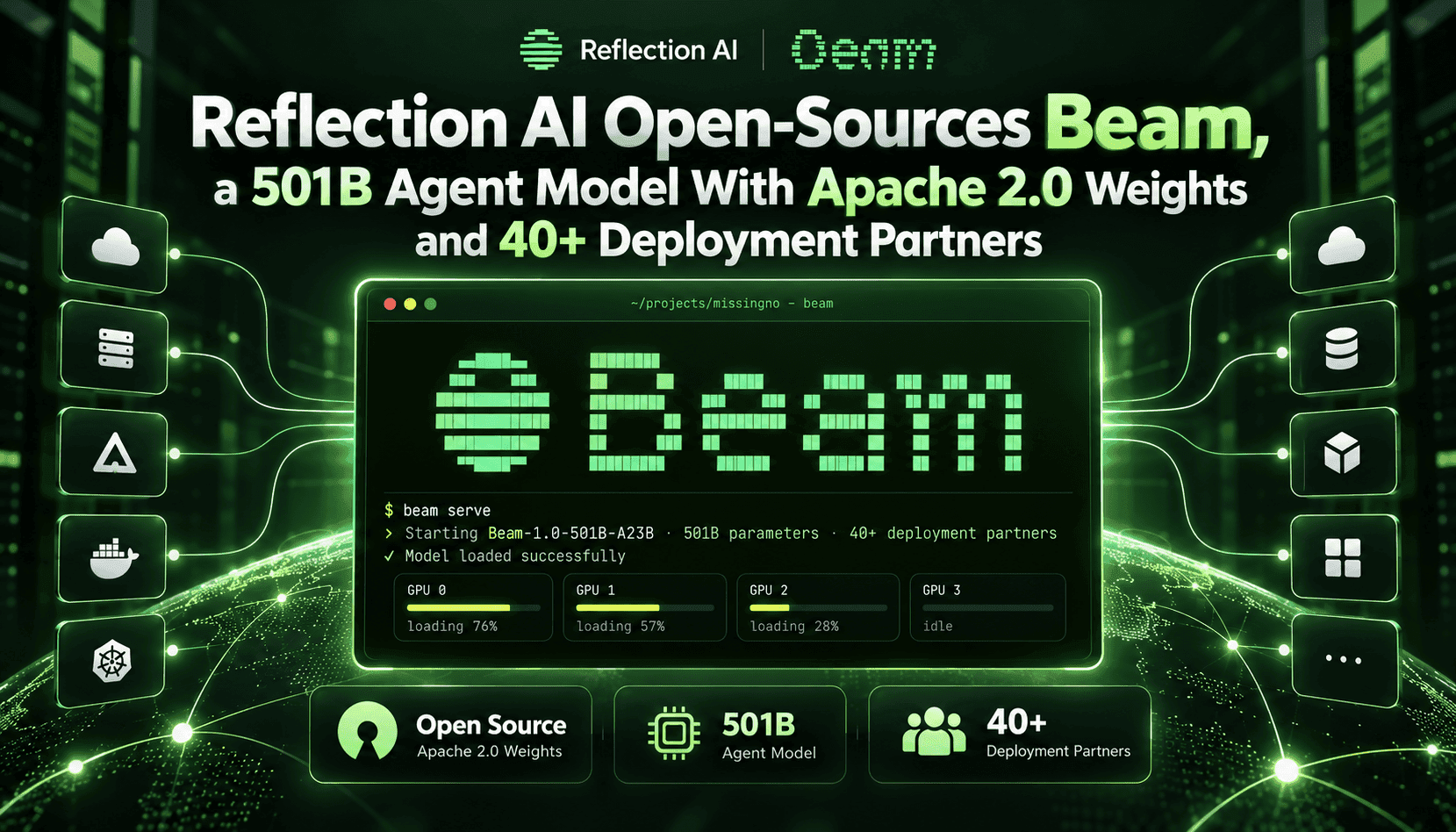
AI BriefReflection’s Beam release combines an architecture designed for coding, reasoning and long-horizon agents (501B total / 23B active sparse MoE) with a permissive Apache 2.0 license and a broad partner network. For enterprises this unlocks behind-the-firewall deployments, reproducible inference stacks, and deep customization paths — from LoRA and self-distillation to RL fine-tuning — while offering multiple deployment routes across hyperscalers, inference vendors and on-prem vendors.
Reflection’s Beam is notable not just for scale, but for its packaging: a sparse mixture-of-experts architecture with 501 billion total parameters and roughly 23 billion active parameters per token. That design targets token efficiency and long-horizon planning — attributes useful for coding assistants and agentic workflows where models must reason across long traces and generate or critique multi-step plans. The public release includes weights in BF16, FP8 and NVFP4 formats plus a speculative drafter, letting teams pick precision and cost trade-offs from day one.
The Apache 2.0 licensing is the other headline: enterprises can self-host, modify, and integrate Beam without restrictive vendor constraints. For security-conscious buyers and regulated organizations, that means the ability to run validated inference inside air-gapped or sovereign environments, to audit and patch model code, and to build internal fine-tuning workflows. It also removes legal uncertainty for redistribution and internal-commercial use, accelerating adoption by cloud partners, system integrators, and on-prem vendors.
Reflection pairs the model release with a broad software and partner play: Mirror CLI for agent harnessing, reference inference stacks, observability, reinforcement-learning recipes, and integrations with 40+ partners including hyperscalers, inference providers, and hardware vendors. That combination is important because a model alone rarely becomes production-ready. Offering inference kernels, quantized formats, and agent tooling reduces integration friction and makes Beam usable for enterprises that need operational stability and reproducible evaluations.
Still, important gaps remain. Beam’s benchmarks and safety report provide a starting point, but real-world enterprise adoption will hinge on third-party validation, longitudinal safety audits, and the maturity of partner deployments — especially around operator tooling, observability, and latency-sensitive inference. This article breaks down what changed, how to deploy Beam across clouds and on-prem, how to customize and fine-tune it, and whether Beam can realistically challenge closed-weight frontier models for production agent workloads.
Key Takeaways
Open weights + permissive license = enterprise control
Apache 2.0 lets organizations self-host Beam, audit behavior, and integrate models into air-gapped or sovereign environments without restrictive licensing hurdles.
Multiple realistic deployment paths
Start with managed partner endpoints for evaluation, stage on hyperscalers with optimized kernels, then move to on-prem or OEM solutions for sovereignty and production SLAs.
Customization requires ops maturity
LoRA, RL and self-distillation can improve accuracy and token-efficiency, but they demand reproducible evaluation pipelines, HCI verification and performance tuning for MoE serving.
What Beam Is — Architecture, formats, and immediate capabilities
Beam is a sparse Mixture-of-Experts (MoE) model whose 501 billion parameter count represents the total capacity, while inference touches about 23 billion active parameters per token. That split is a deliberate trade-off: high peak capacity for heterogeneous, compositional tasks and lower inference compute during steady operation. The release includes model weights in BF16, FP8, and NVFP4, plus a speculative drafter for responsive decoding. For developers focused on code generation, multi-step reasoning or agentic tool use, the architecture is designed to reduce token cost while preserving expressivity where it matters.
Practically, expect Beam to excel in workflows that require scratchpad-style planning, writing and executing code, and chaining tool calls across long contexts. Early demos show efficiency in build tasks and multi-model comparisons. But MoE behavior complicates latency predictability and requires tuned serving (expert routing, kernel fusion, and quantization) to meet SLAs; Reflection’s partner integrations address many of these operational details out of the box.
Why Apache 2.0 matters for enterprises
An Apache 2.0 license is more than a legal nicety. It permits enterprises to self-host, fork, and modify weights and associated code without worrying about copyleft obligations. That enables air-gapped deployments, full chain-of-custody audits, integration into internal CI/CD pipelines, and production deployments where policy or regulation forbids external API calls. For procurement and legal teams this simplifies vendor risk assessments and avoids restrictive commercial terms that can block internal innovation.
Operationally, Apache 2.0 lowers friction for system integrators and OEMs who want to embed the model in hardware or firmware. It also encourages the broader ecosystem — quantization tools, RL fine-tuning recipes, observability SDKs — to adopt permissive licenses, creating a virtuous cycle that enterprises can consume without re-negotiating licenses or waiting for bespoke agreements.
Deployment routes: clouds, inference providers, and on-prem practicalities
Beam is available through many partner endpoints and as downloadable weights, giving teams three realistic deployment patterns: (1) Managed endpoints on cloud or inference vendors (Reflection API, CoreWeave, Nvidia NIM, Ollama, OpenRouter) for fast testing and frictionless scaling; (2) Hyperscaler-hosted self-managed clusters (AWS, GCP, Azure, Databricks) using optimized stacks (vLLM, SGLang, Transformers) and instance families tuned for MoE; (3) On-prem and sovereign deployments with OEMs (Dell, HPE) or private clusters using fused kernels and quantized formats to fit local GPUs or Blackwell-class inference hardware.
Practical advice: start with a managed partner endpoint for evaluation, then move to self-hosted staging with BF16/FP8 weights on representative hardware to measure routing, memory and latency. Use Mirror CLI or supported harnesses to reproduce agent traces locally. For production, choose partners who supply fused kernels or NVFP4 support (NVIDIA, CoreWeave, Cloud vendors) and validate tail-latency under production agent loads before cutting over.
Customization, RL and self-distillation pipelines
Reflection published recipes and partnered with TRL, NVIDIA, RadixArk and others to support fine-tuning, RL workflows and self-distillation loops. Enterprises can train LoRA adapters, run RLHF or larger-scale RL runs, and adopt self-distillation approaches to make Beam more token-efficient for specific tasks. Reflection’s own training runs — millions of sandboxes and large RL experiments across GCP and AWS — indicate the model benefits from iterative, environment-driven tuning when used as an agent kernel.
Operationally, custom training requires careful evaluation: set up automated evaluation suites, human-in-the-loop verification for safety-critical tool calls, and reproducible sandboxes to compare variants. Self-distillation recipes that generate verified traces and train LoRA adapters can reduce cost and improve task success rates, but they depend on high-quality trace generation and robust validation before deployment.
Risks, limitations and whether Beam can displace closed-weight frontier models
Beam’s combination of permissive licensing, partner breadth and agent tooling is a credible counterpoint to closed-weight dominance, but replacing frontier proprietary models depends on three things: parity in core capabilities, parity in operational SLAs (latency, throughput, monitoring), and ecosystem trust (benchmarks, third-party audits). Early demos show strong code and planning capacity, but independent benchmarks and production reliability tests will determine enterprise confidence.
Limitations to watch: MoE routing can produce variance in latency and cost; specialized fused kernels are still maturing; some downstream tools and vendor ecosystems remain optimized for dense models. That said, the open operating system approach — Mirror CLI, partner inference stacks, and RL/customization recipes — materially lowers the barrier for organizations that prioritize transparency, sovereignty and tight integration over 'best-in-show' closed APIs.
Frequently Asked Questions
Can my company run Beam entirely on-premises behind the firewall?
Yes. The Apache 2.0 weights are downloadable and Reflection’s partners (Dell, HPE) offer enterprise on-prem appliances and deployment guidance. You should validate hardware compatibility for MoE serving, use supported precision formats (BF16/FP8/NVFP4), and test fused kernels to meet latency and throughput requirements before full production rollout.
Which deployment path should I choose for initial evaluation?
Start with a managed endpoint from a partner or Reflection’s API to validate capabilities quickly. Then stage a self-hosted setup on representative cloud VMs (AWS/GCP/Azure) using vLLM or SGLang and the provided precision formats to measure real-world latency and routing costs before committing to on-prem.
How practical is customization (RL or self-distillation) for enterprise use cases?
Customization is practical but resource-intensive. Use LoRA adapters for targeted improvements, self-distillation to boost token efficiency for repeated tasks, and RLHF or larger RL runs for policy-style behavior changes. Crucially, build automated evaluation suites and human verification to avoid regressions and ensure safety during iterated training cycles.