

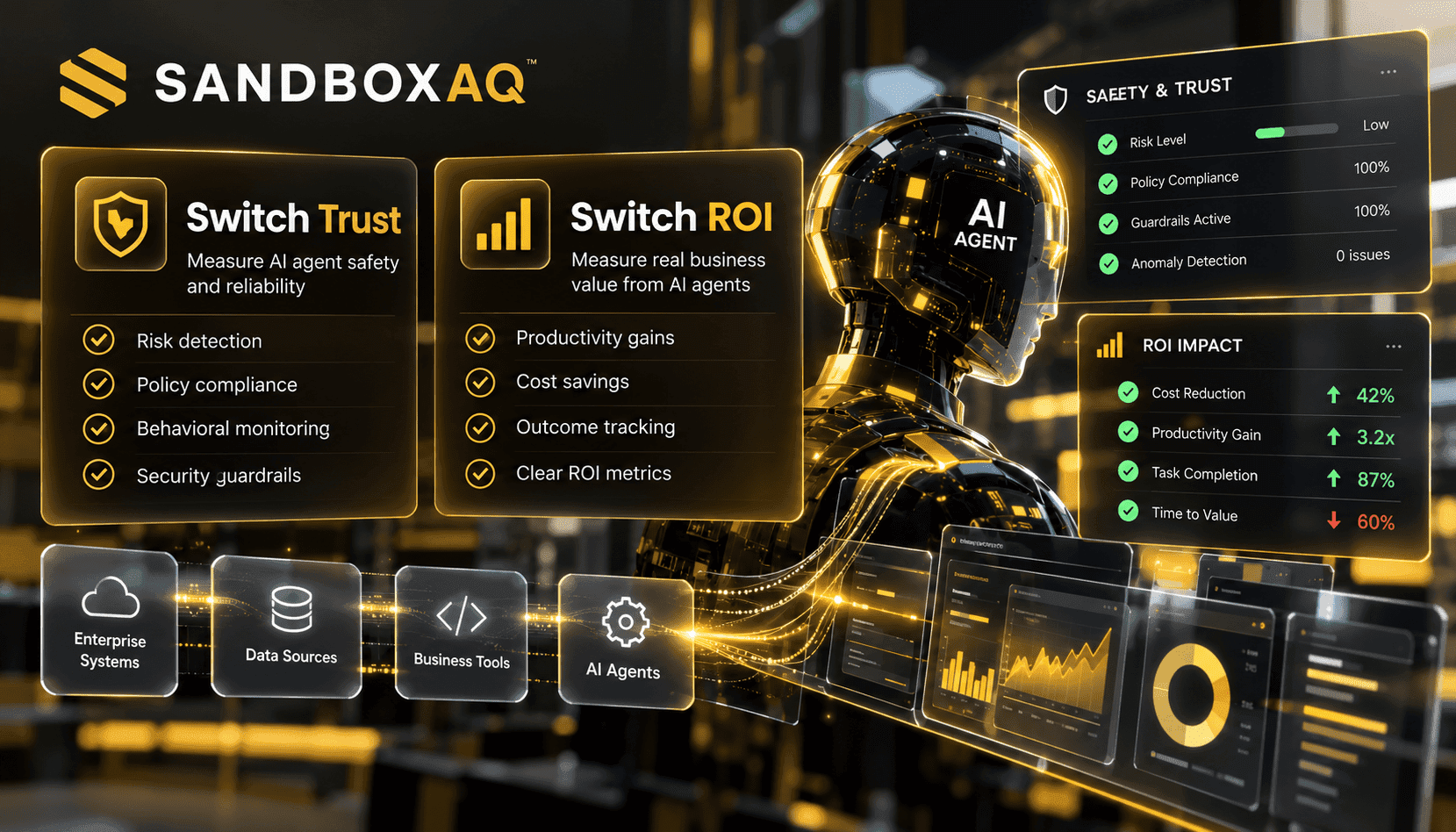
The enterprise agent problem has two stubborn gaps: visibility and value attribution. Teams can inspect API bills and token usage, but those tallies don’t answer which agents are completing valuable tasks, where security vulnerabilities appear at runtime, or which automations are wasting budget. SandboxAQ’s launches — Switch Trust for discovery and risk monitoring, and Switch ROI for spend-to-outcome attribution — tackle those gaps directly. Together they promise an operational layer that both surfaces risky agents before they cause incidents and shows finance and product teams which autonomous workflows deserve more budget.
Switch Trust is primarily a discovery and runtime-risk offering. It maps active agents across an environment, enumerates permissions and data flows, and runs targeted tests to expose configuration issues, prompt injection paths, and fragile decision logic. Importantly, it shifts from static policy checks to runtime observation and active probing: by exercising agents with controlled inputs, Switch Trust reveals brittle behavior that static scans miss. For security and ops teams, that means earlier detection of exploitation vectors and a prioritized list of remediation steps tied to business impact.
Switch ROI answers a different but complementary question: which agents are creating measurable business value? Rather than stopping at cost accounting, it links agent-level resource consumption and task outcomes to business KPIs. That requires instrumenting agents with outcome markers, measuring completion quality or conversion, and aligning those signals with cost buckets. The result is a per-agent ROI picture that helps product managers and finance teams stop funding low-impact automations and scale the ones that demonstrably move metrics.
Adopting both tools changes how teams operate: security gets earlier warning about exploited agents; operators get concrete failure modes and performance baselines; finance gets attribution that turns token usage into economic decisions. But the value depends on discipline—instrumentation, agreed outcome metrics, and governance workflows that act on the signals. The remainder of this article breaks down functionality, practical implications, a reproducible evaluation framework, and the limits teams should expect when deploying Switch Trust and Switch ROI across heterogeneous enterprise estates.