

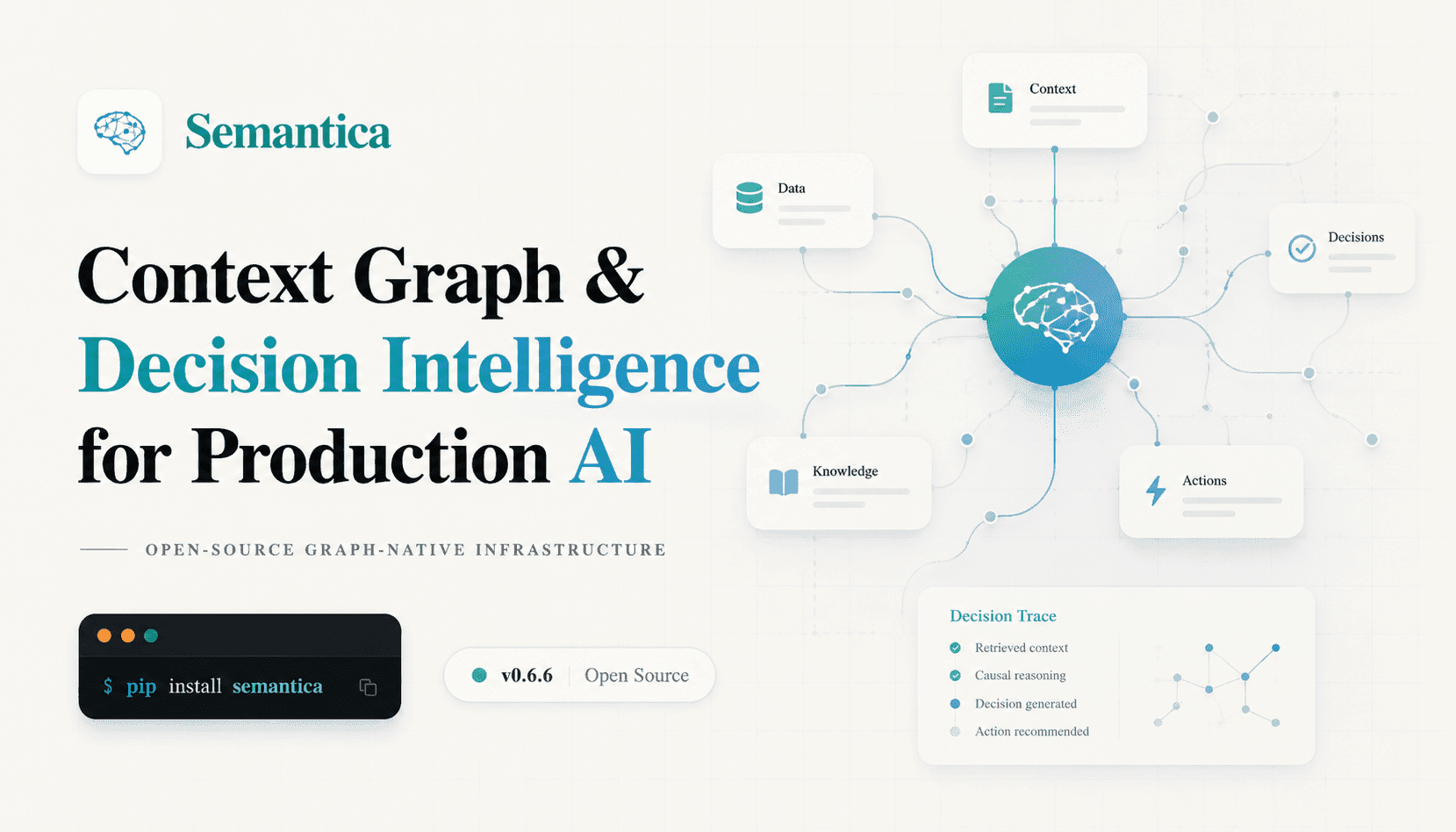
Most agents today can call tools, write code, and move tickets—but they struggle to explain themselves. A recommendation might be correct, yet nobody can trace the evidence, timing, or dependencies. Semantica tackles that gap by converting disparate enterprise artifacts—docs, tables, API payloads, logs—into a persistent, time-aware context graph. Instead of tossing everything into embeddings, it models entities, facts, events, and decisions as linked nodes with provenance and versioning. Agents then retrieve subgraphs, not just nearest neighbors, so plans reference concrete objects and relationships. This reframes memory from fuzzy recollection to accountable knowledge, giving both developers and risk teams a substrate for reliable automation.
Operationally, a context graph changes how work flows across systems. Procurement agents can justify a vendor choice by pointing to policies, quotes, and prior incidents; support agents can connect incidents, fixes, and component changes; finance bots can align transactions to policies and approvals. Because nodes carry lineage and timestamps, you can reconstruct what the agent knew at the moment of action—critical for audits and postmortems. The practical benefit is fewer contradictory steps, less rework across teams, and more stable results across runs. It also enables multi-agent coordination: separate skills operate on shared, structured memory rather than maintaining brittle, private caches of embeddings and notes.
There are trade-offs. Graphs demand schema thinking, data contracts, and a patience for integration that simple vector drop-ins avoid. But the payoff is compounding. Once your core entities and relationships are modeled, every new workflow inherits explainability, deduplication, and safer autonomy. Practically, start with a single, auditable decision loop—change management, vendor selection, or KYC—and prove value with traceable outcomes and reduced policy exceptions. Instrument your evaluation harness to measure hallucination rate, decision traceability coverage, latency under load, and total cost of retrieval. If those metrics move in the right direction, expand connectors and formalize governance over who can write, read, and time-travel the graph.