

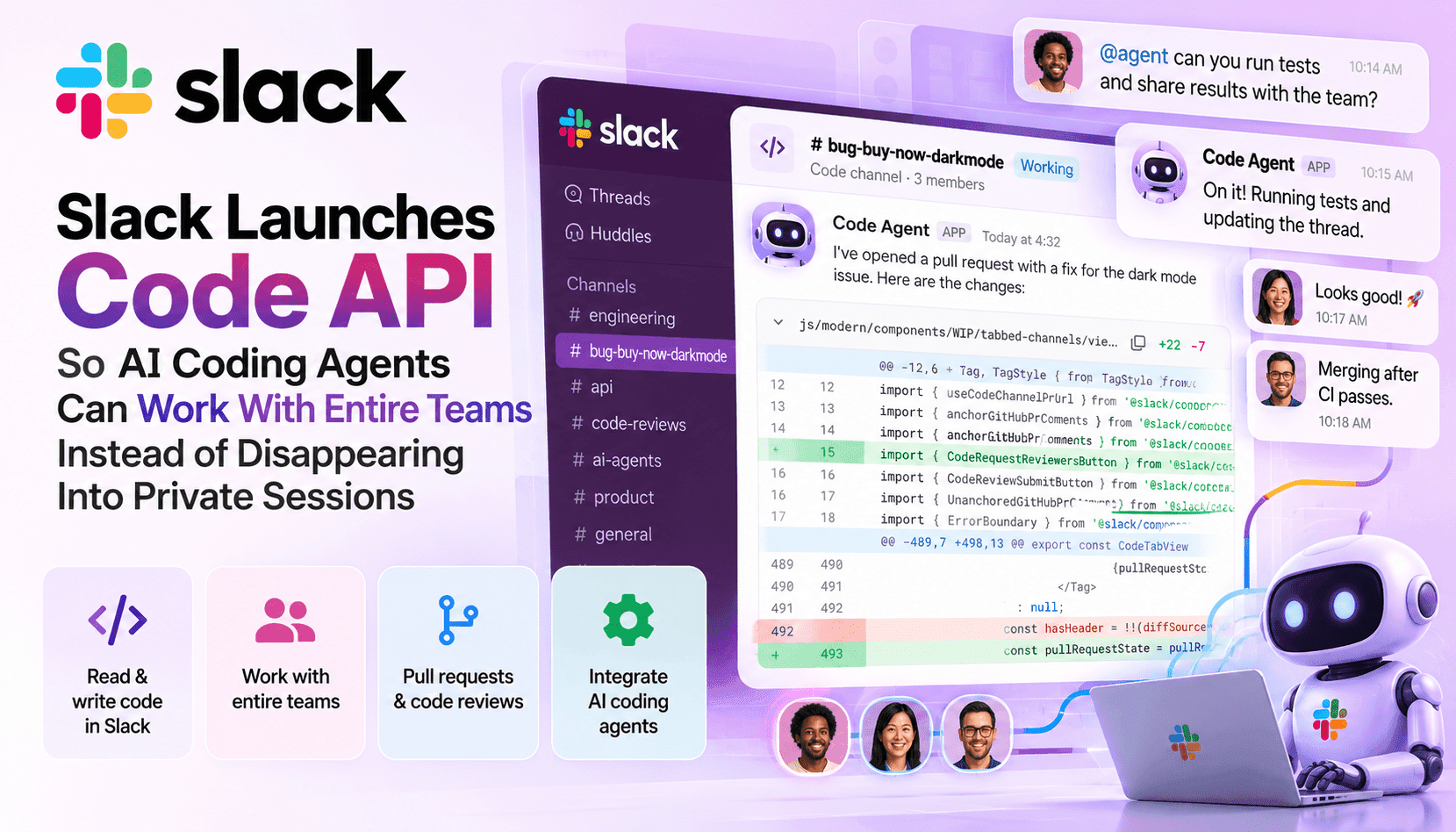
Slack’s Code API is a practical attempt to solve a growing problem: autonomous coding agents that disappear into private sessions and leave teams blind to what changed and why. Rather than shoehorning agents into generic DMs or cramped threads, the Code API creates purpose-built code channels where an agent can bring the exact people, project context, and artifacts it needs. That shift—agents working openly in the same collaboration fabric as humans—changes how teams review, approve, and learn from automated work.
Technically the API provides primitives for channel creation, membership, bookmarks, diffs, execution updates, and archival. Agents can declare a channel name, push code previews or diffs, attach logs and test results, and post stepwise plans that teammates can interrogate. Slack also maps agent actions to workspace permissions and compliance controls, so the same access rules and message governance that apply to people apply to agents. That design choice reduces integration surface for IT while preserving a searchable audit trail.
The early usage signal is instructive: GitHub Copilot reportedly opens a dedicated code channel for roughly 30% of its agent sessions. That suggests many agent tasks are task-sized and team-relevant rather than trivial replies. For platform and tooling teams, Code channels become a place to centralize approvals, surface context, and recover institutional knowledge. For product and ops leaders, they represent a live experiment in human-in-the-loop agent governance and distributed code ownership.
But visible agent work is not a cure-all. Turning agent runs into public artifacts changes developer ergonomics, creates noise risks, and requires careful UX choices so channels are useful rather than cluttered. It also reshapes vendor integrations: marketplaces, model providers, and CI/CD tools must now think in terms of multiplayer workflows. The practical test for teams will be whether the benefits—faster review cycles, shared learning, and clearer accountability—outweigh the cost of surfacing more intermediate agent output.