

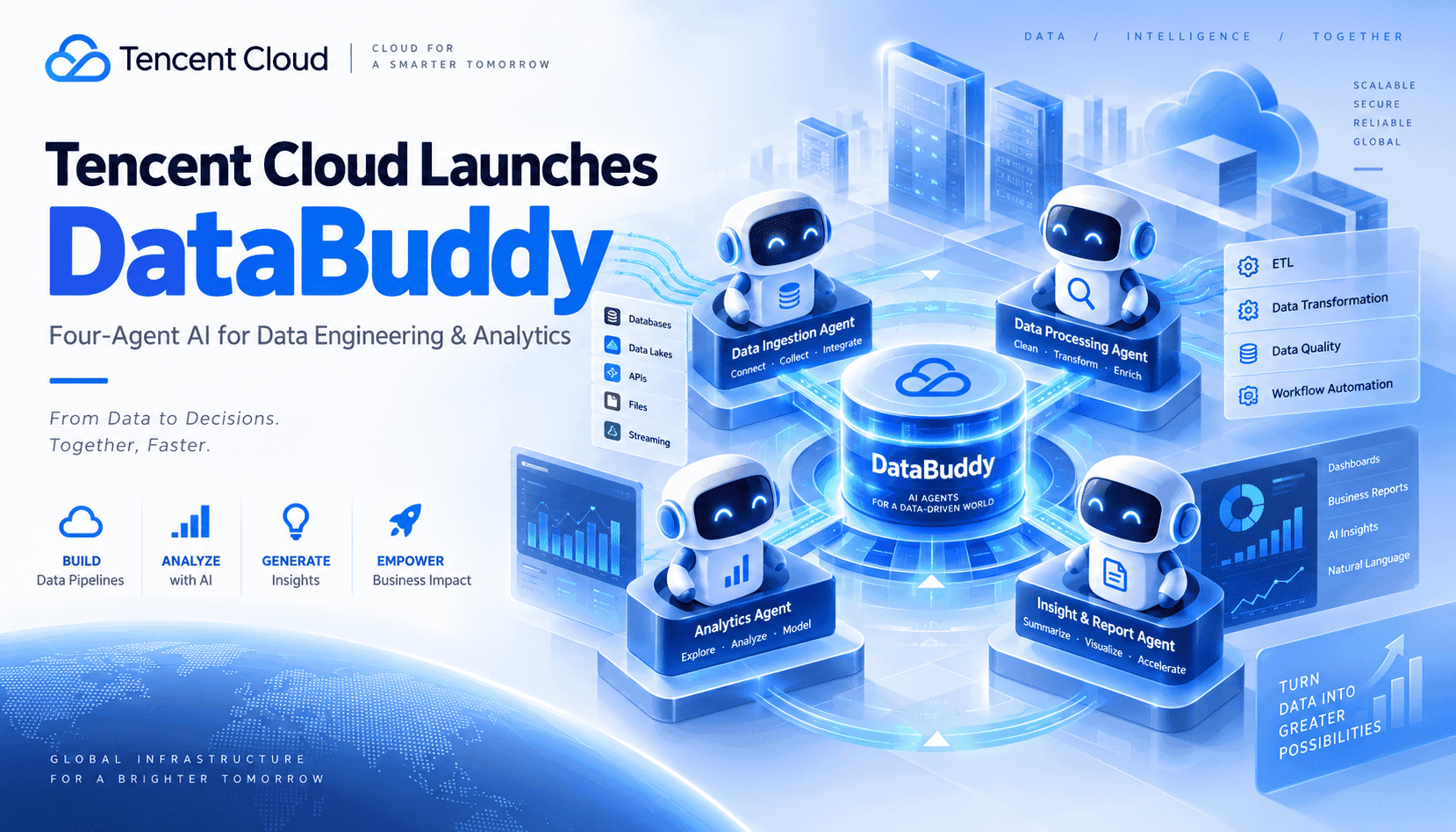
Tencent Cloud’s DataBuddy packages a four-agent pattern into a service that addresses the most chronic enterprise data pain: slow, ticket-driven ETL and BI changes. Instead of routing requests through overworked engineers, DataBuddy orchestrates agents to assemble pipelines, write SQL, and explain outputs under governance rules. The approach is opinionated but pragmatic: codify routine data work into agent roles, measure them like services, and keep humans in review for access, privacy, and cost. This shift mirrors how DevOps matured—tooling, automation, and policy replacing heroics and spreadsheets.
Under the hood, one agent plans tasks, one acts like a data engineer generating connectors, transformations, and SQL, a third functions as an analyst producing insights and narratives, and a fourth reviews for quality and policy alignment. That last role matters: it checks schema assumptions, joins, leakage risk, and PII exposure before results ship to dashboards or notebooks. When instrumented properly, logs capture prompts, decisions, generated code, and lineage so teams can reproduce outcomes, roll back changes, and compare agent performance across datasets—key for trust and audit.
Where does this fit? Think of DataBuddy as a control plane that sits between your lakehouse and your consumers. It should complement existing Spark/SQL jobs, cost governance, and catalog tooling rather than replace them. The sweet spots are backlog-heavy BI changes, ad hoc exploration that must still respect policies, and repetitive ingestion or data quality tasks. The open questions are enterprise-grade: how it binds to identity, catalogs, and VPC networking; how it enforces least privilege at the table/column level; and how it allocates compute to cap spend without throttling throughput.
Decision framing: pilot with a bounded domain (e.g., sales ops or marketing attribution), a known fact table, and two trusted dimensions. Define pass/fail criteria: time-to-first-insight, query accuracy versus gold SQL, data quality violations caught, and cost per successful task. Route outputs to existing dashboards, not a new silo. Keep a human reviewer in the loop for policy exceptions. If the pilot clears thresholds, scale by adding data products, not random tables—treat each product as a contract with SLAs, lineage, tests, and alerting, with DataBuddy agents as the execution layer.