

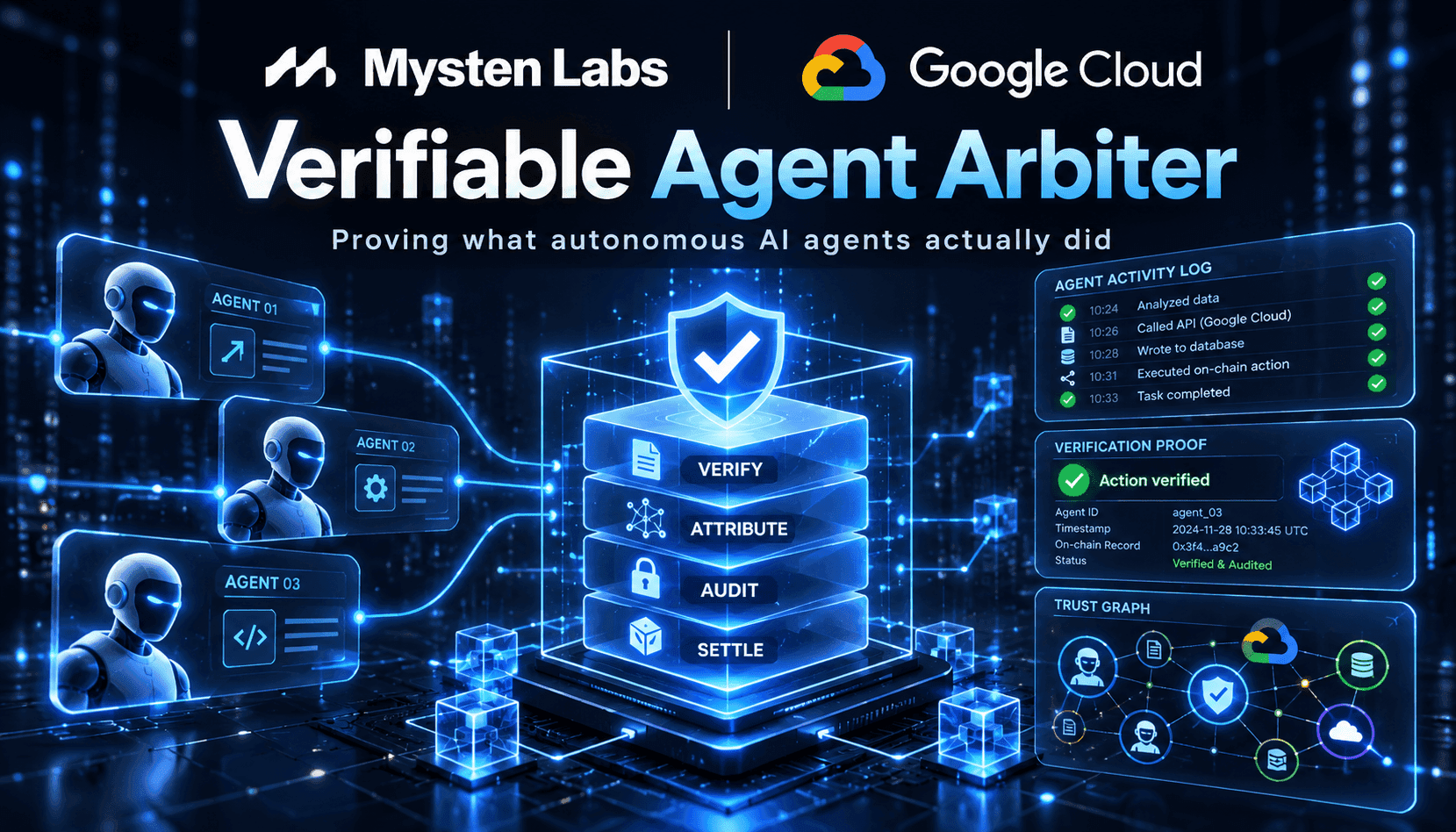
Autonomous agents are already touching financial flows, contractual commitments, and multi‑party workflows. Mysten Labs’ Verifiable Agent Arbiter, built in collaboration with Google Cloud, is pitched as an evidence layer: it doesn’t try to police models or replace telemetry systems, but to produce compact cryptographic receipts that anyone with the right inputs can verify independently. That distinction — preserving detailed logs privately while exposing tamper‑evident proofs publicly or to counterparties — is what makes VAA a practical tool for enterprises that must demonstrate what agents were permitted to do and what they actually executed.
Enterprises need that capability for three converging reasons: operational risk, legal liability and regulatory compliance. When agents negotiate deals, transact across organizations, or call payment rails, a disputed outcome can force lengthy reconciliation or legal fights. With verifiable receipts, firms can replay a workflow deterministically against the same artefacts to establish whether a contract was honored or an instruction misfired. Regulators are also moving from guidance to enforcement — for example, the EU AI Act will impose heavy penalties for inadequate logging — so provable logs are rapidly shifting from a ‘nice to have’ to a compliance requirement.
VAA’s architecture separates private telemetry from proof. Full telemetry — prompts, model outputs, tool calls, and policy decisions — remains in customer‑controlled Google Cloud Storage. Compact cryptographic commitments of that telemetry are written to Walrus and coordinated via Sui, a Layer‑1 that provides neutral anchoring and long‑term durability. That pattern allows security and legal teams to reconstruct incidents without exposing operational secrets, while also enabling future re‑proofing under new crypto standards, including post‑quantum algorithms, preserving evidentiary value across cryptographic migrations.
The practical upside is tangible: dispute replay across companies, faster incident reconstruction, accountable agentic commerce and durable archives that survive key rotations or algorithmic upgrades. Early enterprise pilots will focus on high‑risk workflows — finance, procurement, customer‑facing transactions and intercompany service settlement — where a verifiable chain of authority and action reduces friction and legal exposure. Still, adoption requires engineering work: instrumenting agents to emit the right telemetry, integrating receipt verification into workflows, and updating SLAs and legal agreements to reference cryptographic proofs.