

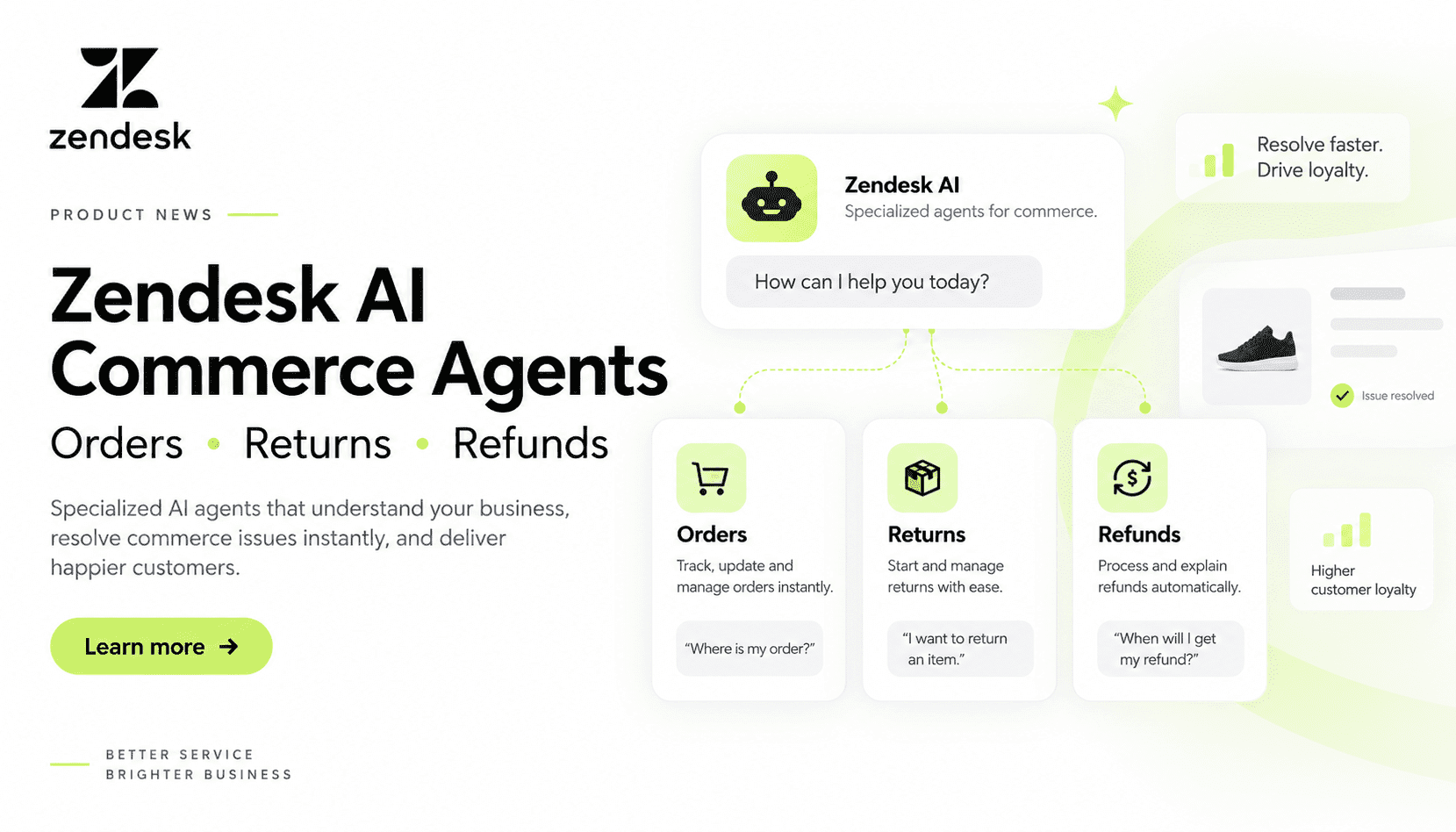
Zendesk’s specialised AI Agents for commerce reposition customer service as a transactional engine. Rather than answering questions and escalating, these agents place orders, trigger exchanges, issue refunds, resolve delivery issues and reconcile payments by calling into connected retail systems. The pitch: collapse multi-step journeys across storefront, OMS, shipping and payments into a single interaction, measurable against first‑contact resolution and cycle-time goals instead of deflection alone.
Two elements stand out. First, prebuilt Industry Agents encode common commerce tasks, reducing design debt and time-to-value. Second, an Agent Builder lets teams define custom jobs, action policies, data sources and when to seek human approval. With integrations to platforms like Shopify for order state, Narvar for post‑purchase events, Stripe for payments and Riskified for risk signals, the agents can both retrieve context and execute actions with auditability and guardrails.
If realised in production, this changes how CX teams staff, measure and govern. Success moves from message containment to outcome attainment: refund cycle time, exchange completion rate, chargeback ratio, policy abuse catch rate, inventory reallocation speed and CSAT for resolved cases. The Australian market pressure cited by Zendesk—customers churning after poor first-contact outcomes—underscores why specialised, policy-aware agents may outperform general chatbots in retail’s repetitive, rules-heavy workflows.
The risk surface also shifts. Action-taking agents require rigorous permissions, deterministic approvals for high‑value steps, fraud‑aware routing and immutable logs for disputes. Buyers should treat deployment like introducing a new operational tier: stage with synthetic orders and historical edge cases, tune thresholds with finance and risk, then graduate to production with coverage maps and rollback plans. The upside is real if teams design for accountability, not novelty.