

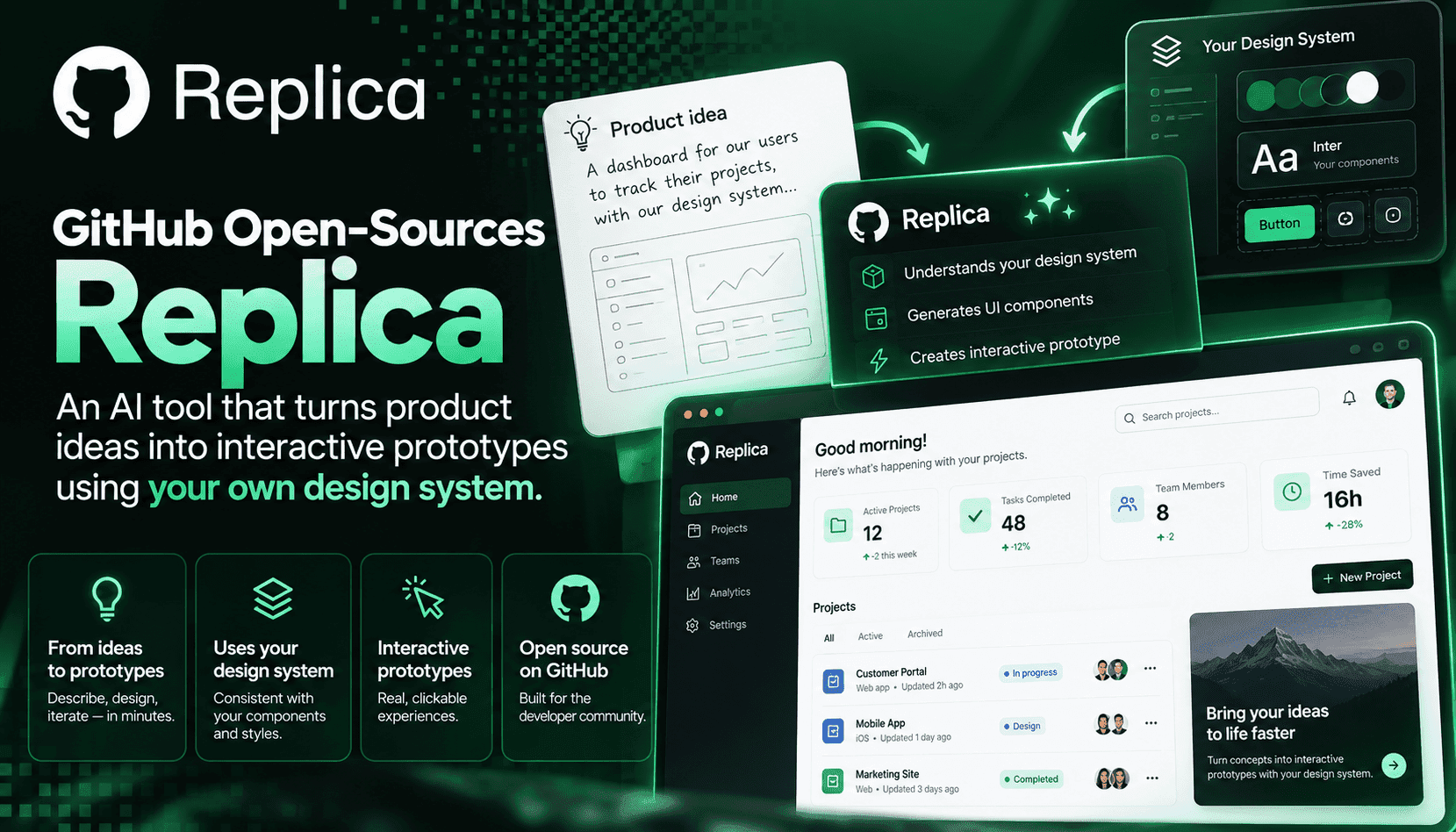
Replica is best read as an operational idea more than a flashy generator: it’s a workflow that binds natural-language exploration to the concrete primitives teams already ship. Instead of creating fresh, one-off visuals, Replica consults an existing component library, design tokens and guidance so the prototype reflects the product’s true constraints. That difference matters downstream—designers preserve interaction logic and engineers get prototypes that are materially closer to implementation, reducing rework during handoff and surfacing integration trade-offs earlier in the cycle.
Contrast this with generic vibe-coding tools that synthesize interfaces from style prompts or by learning visual trends. Those tools can be fast for ideation but often produce artifacts that don’t map to a team’s component API, token semantics, or accessibility rules. The result is a persuasive mockup that still needs to be rebuilt. Replica’s approach places the design system, documentation, and component surface as the source of truth—so iterations are grounded in what can be shipped rather than what looks plausible.
Practically, Replica sits between conversation-driven design assistants and code-first builders. It’s a collaborator for product managers and designers who want to explore flows without inventing new visuals, and a scaffold for engineers who will ultimately own the components. That positioning brings trade-offs: teams must have a maintained, documented component system for Replica to add value, and they’ll need to adopt modest governance around which components Replica is allowed to instantiate and how tokens map across platforms.
For decision-makers, the core question isn’t whether AI can sketch interfaces—it's whether prototypes become durable inputs to engineering. Replica reduces translation costs by keeping prototypes tethered to real components, which narrows the gap between exploration and implementation. But it also introduces operational demands: component quality, test coverage, and documentation need to be reliable, or the prototype’s fidelity will be misleading rather than helpful. The rest of this article breaks these dynamics into actionable comparisons, risks and a suggested adoption path.