

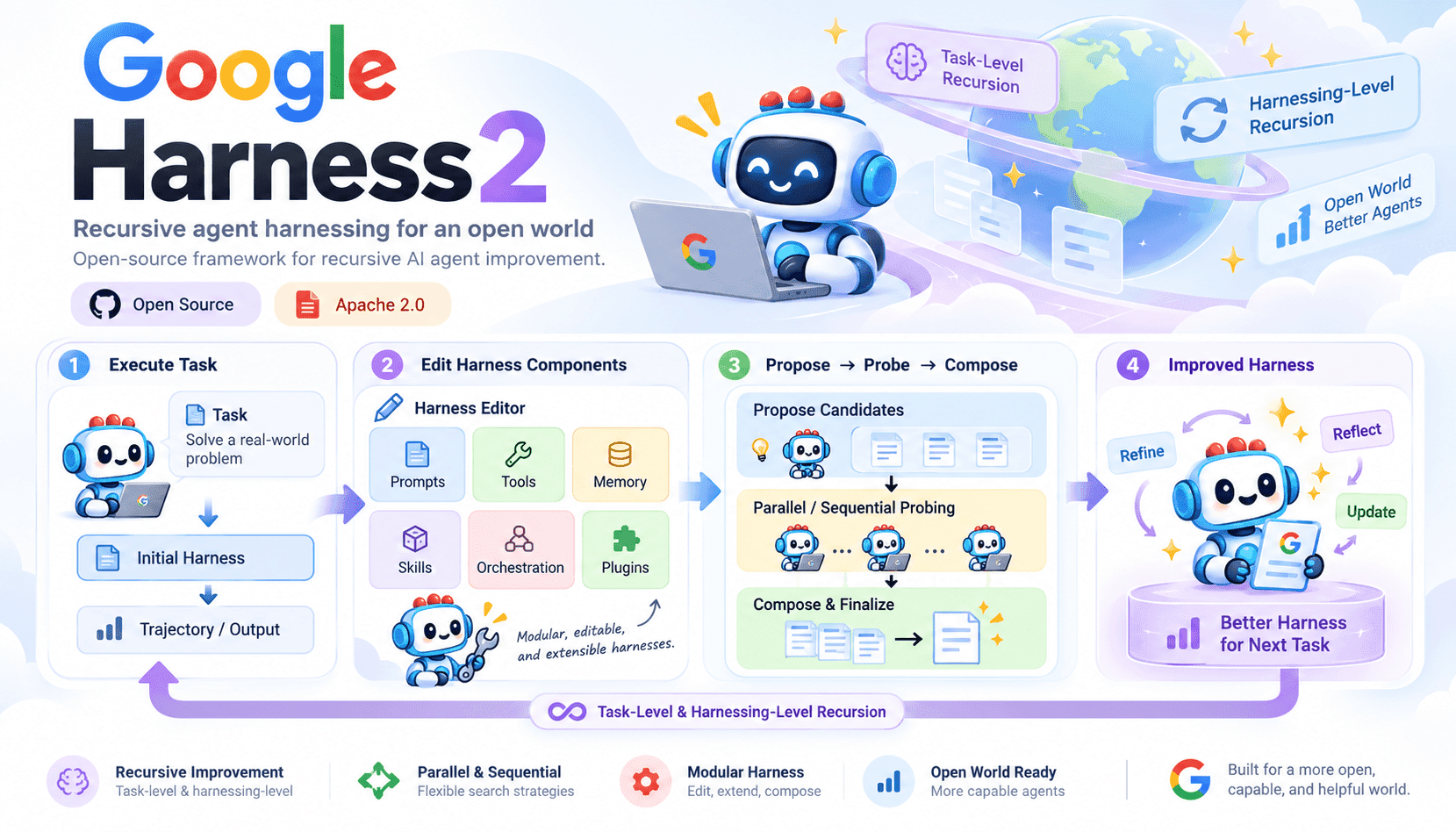
Harness² reframes agent improvement as a systems problem rather than a model‑update problem. Instead of altering model weights, the framework iteratively edits the agent’s harness — the collection of system prompts, guardrails, memory schemas, tool guidance, subagents and scripts that shape behavior — and uses contrastive execution to accept only edits that demonstrably improve outcomes on the same task. That approach fits enterprise constraints where models are fixed for compliance, cost, or certification reasons, while still enabling step‑wise behavioral improvement through reproducible, testable harness edits.
Practically, Harness² executes a Propose–Probe–Compose loop: editors propose candidate harness changes, the harness runs the same task multiple times to probe behavioral differences, and a composer synthesizes a new harness that keeps changes empirically supported by observed outputs. The system implements two recursion levels. Task‑level recursion focuses on the immediate job (parallel proposals or sequential refinement steps controlled by a --k budget). Harnessing‑level recursion persistently records adopted harnesses and lessons so future tasks begin with a stronger starting harness, enabling transfer without explicit supervised labels.
Benchmark results reported by the project show nontrivial improvements using fixed models: single Harness² steps improved GLM‑5 and Gemini 3.5 Flash across WorkBuddy‑Bench, JobBench and LAB, with gains up to roughly 11.5 points on WorkBuddy, 4.5 on JobBench and nearly 12 percentage points on LAB’s partial pass metric. The framework supports OpenCode and Codex‑style executors, parallel and sequential recursion modes, and practical tooling for local dry‑runs and judged benchmark evaluation. These gains demonstrate harness optimization can be a high‑leverage engineering path when model changes are impractical.
For developers building coding agents, enterprise assistants or autonomous workflows, Harness² offers concrete operational mechanics: define editable harness components, craft deterministic editors for candidate edits, instrument robust probes (repeatable task executions and judges), and maintain a persistent improvement harness that captures evidence‑backed lessons. The repository includes demo flows that run without model credentials, plus instructions for Vertex AI, Codex executors and Dockerized benchmark setups. The Apache‑2.0 license makes integration and redistribution straightforward for teams that need a permissive license.