

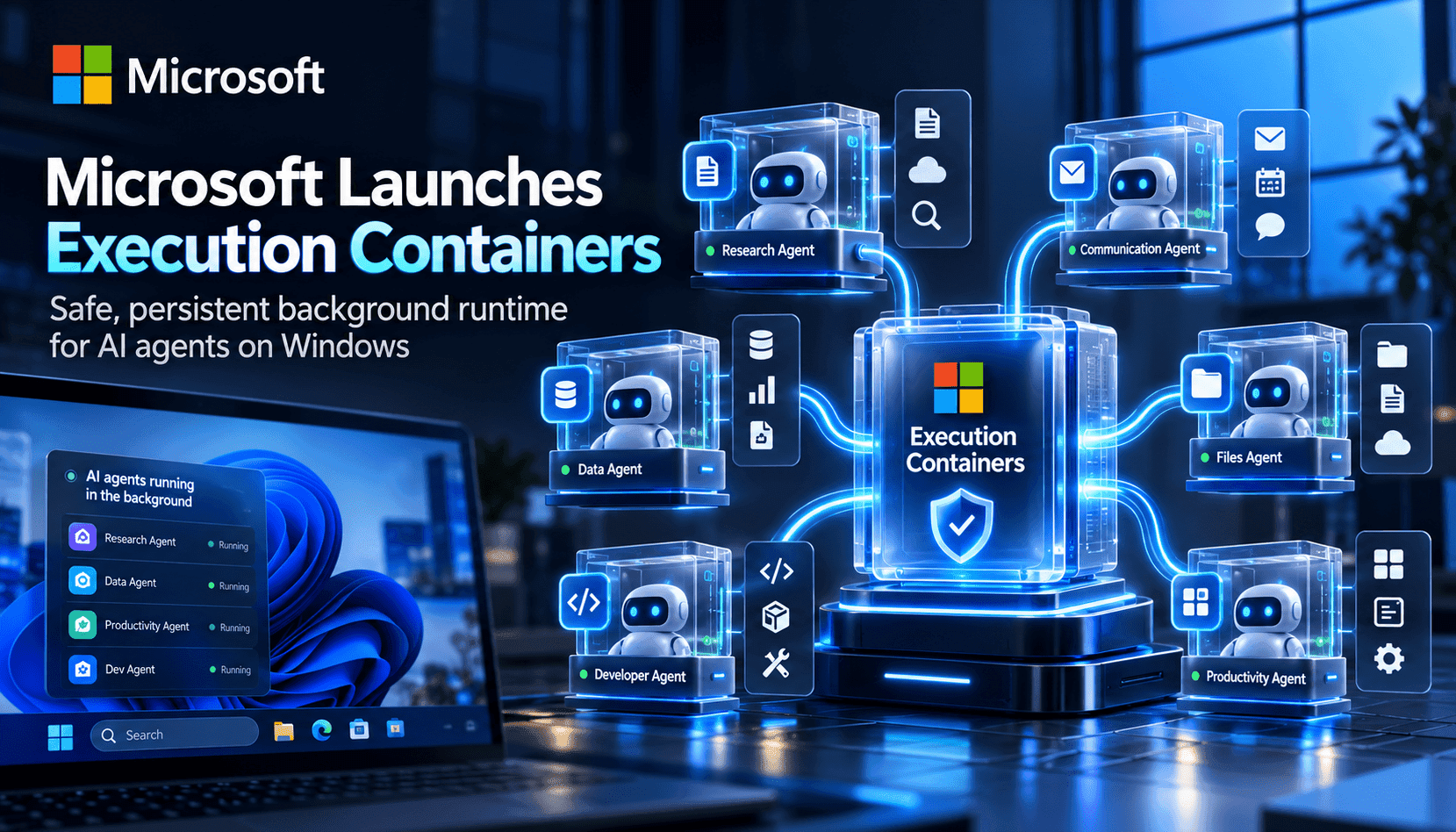
Microsoft Execution Containers (MXC) are a deliberate evolution in how operating systems accommodate autonomous AI agents. Rather than leaving agents to run with user privileges or be blocked outright, MXC gives developers and IT an OS-enforced policy layer that declares what an agent may read, write, call, or show in the UI. That means agents can execute background workflows—editing a repo, running a build, or automating admin tasks—while Windows selects an appropriate containment backend (process sandbox, session container, WSL, or microVM) to enforce those boundaries at runtime.
Technically, MXC separates policy from execution. Developers use a unified JSON schema and a multi-language SDK to express resource requirements—file paths, network destinations, UI access, and process parameters—and MXC maps those needs into platform-specific sandboxes across Windows, macOS, and Linux. That mapping is crucial: it lets a coding agent run fast in a process container for low latency while moving higher-risk workloads to session containers or microVMs. The policy lives outside the agent’s control, preventing the agent itself from escalating privileges or granting access to newly generated code.
MXC also recognizes that safe agent adoption hinges on identity and manageability. Windows plans to integrate Microsoft Entra and Agent 365 attribution so administrators can distinguish agent actions from user activity. Combined with Intune-style policies for MXC containers, organizations gain the ability to apply organizational guardrails, audit agent behavior, and respond to a misbehaving agent without interrupting the employee using the device. For enterprises, that distinction is the difference between a single compromised agent and a full user account incident.
For builders the practical takeaway is straightforward: adopt MXC early in a staged fashion. Start with process containers for developer-facing agents that need quick iteration, use MXC’s Permissive and Learning modes to craft least-privilege policies, and move sensitive pipelines into session containers or microVMs where stronger isolation is needed. Instrument agent workloads to report attempted accesses and adjust policies iteratively; treat denial reports as diagnostic data, not just errors. Over time, consistent containment models will make agent execution as predictable and auditable as containers and sandboxes did for cloud workloads.