

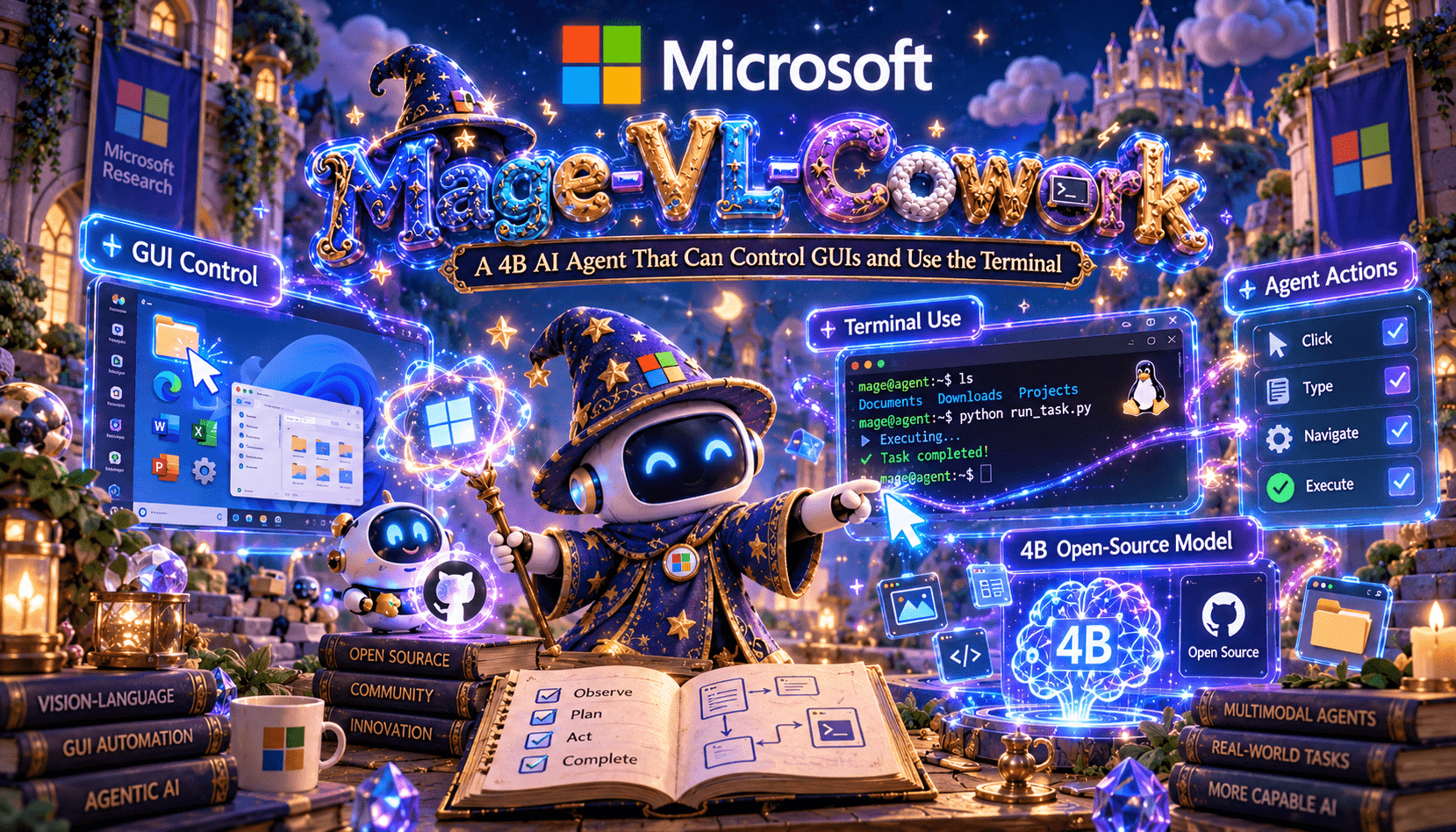
Mage‑VL‑Cowork is notable because it treats desktop automation as a single decision problem: at each turn the policy chooses either GUI primitives (mouse, keyboard, screenshot grounding) or terminal/code actions (scripts, command‑line tools, libraries). That single‑policy architecture avoids brittle orchestration layers and teaches the model both how to act visually and when to switch to programmatic fixes — a capability that maps directly to real user workflows, like editing spreadsheets with a quick Python patch rather than many fragile clicks.
The reported training recipe matters as much as the final number. Microsoft’s five‑stage pipeline — GUI midtraining, GUI SFT, coding & terminal SFT, hybrid SFT, and online hybrid RL — intentionally builds channel competence before unifying them. The harness evolution and Mage‑CUA‑Forge synthesis generate tens of thousands of reusable, skill‑conditioned tasks so the student policy learns both visual grounding and reliable programmatic interventions. Online RL then tightens decision boundaries, reducing model calls and token output while improving success rates — a practical efficiency win for real deployment.
Why does a 4B open‑weight matter? First, it lowers the barrier for teams that want local inference, on‑prem experiments, or edge deployment—especially under Apache‑2.0 licensing. Second, the model’s competitive OSWorld results (66.0% at 50 steps, outperforming several larger closed models) show that careful data engineering and harness design can offset parameter scale. For product teams and researchers, that opens a realistic path to iterate on specialized GUIs, enterprise apps, or privacy‑sensitive automation without waiting for large cloud APIs.