

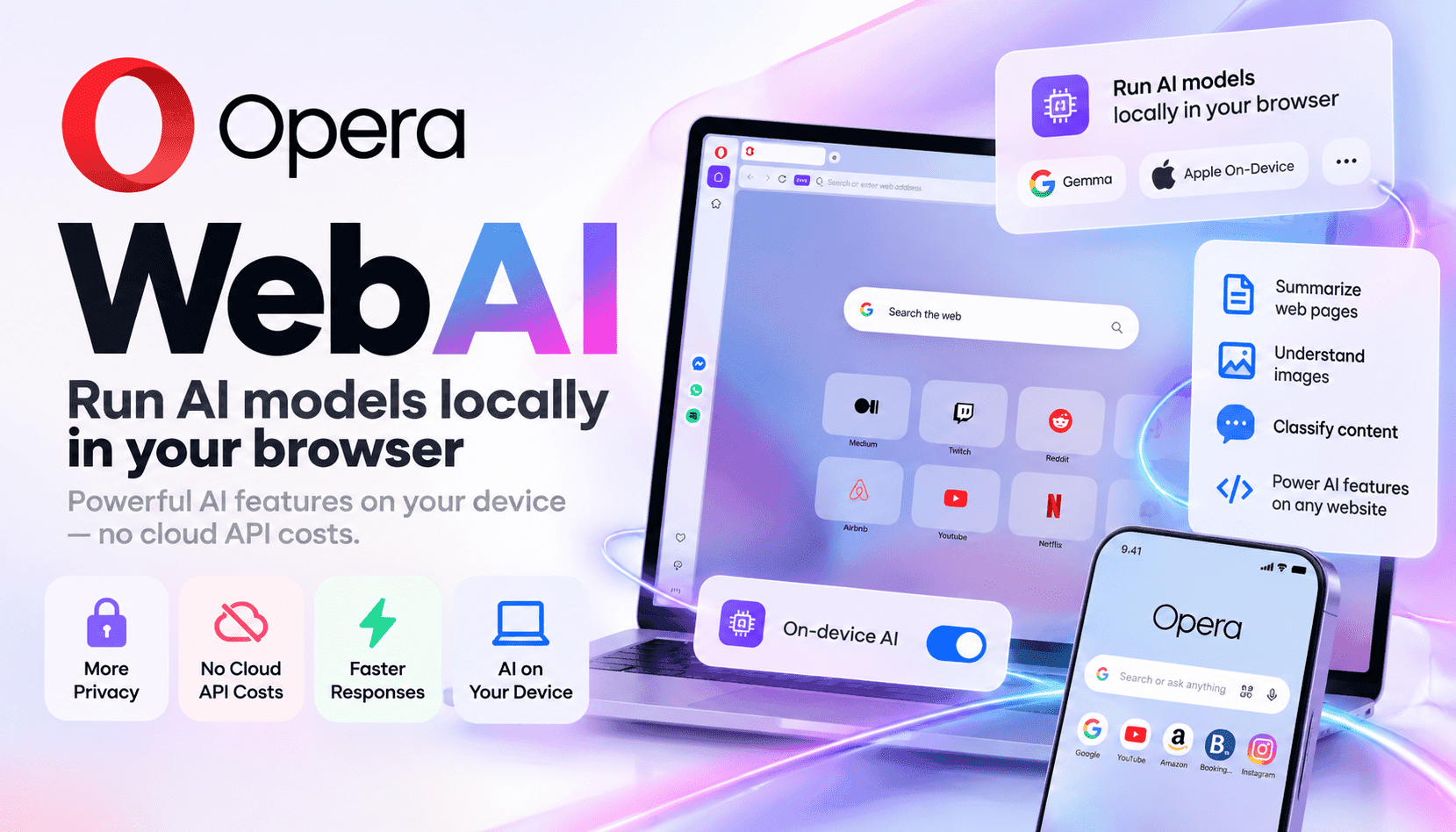
Opera’s WebAI shift is less a single feature than a change in where inference happens. By exposing a browser-hosted AI surface, Opera enables web pages and extensions to call models that run locally on a user’s machine — including preinstalled or opt-in weights from supported vendors. That removes a long-standing operational step for many developers: you no longer necessarily need to run inference servers, manage scaling, or pay per-token API bills for features whose inference cost is modest and latency-sensitive.
Functionally, WebAI is model-agnostic but practical only when the models and hardware align. Opera’s initial rollout lets users opt into Google’s Gemma family and, on Apple silicon Macs, Apple’s on-device foundation model. Those models are chosen because modern ‘‘open weight’’ architectures have become efficient enough to run on everyday laptops and high-end desktops. For developers, that means they can build content classification, summarization, and lightweight generative features without provisioning GPU clusters or paying per-query fees — provided they design for variable device capability.
The practical product effects are tangible. Local execution cuts round-trip time for inference from hundreds of milliseconds or seconds to tens of milliseconds on capable hardware, improving interactivity for live features such as tab organization or inline suggestions. It also keeps sensitive data on-device, reducing regulatory and compliance friction for private-document processing or résumé screening. But it reshuffles responsibility: developers must detect capability, fall back gracefully, and test UX for opt-in model downloads and permissions.
Adoption trade-offs will center on hardware ceilings, model size, and user trust. Devices with limited RAM, CPU, or no neural accelerators will either run tiny models poorly or skip local AI entirely, forcing hybrid architectures. Security and update models matter too: browsers must sandbox model execution, maintain transparent update channels for model weights, and prevent local inference from becoming an exploitable vector. For product teams the question isn’t only technical feasibility but also product-market fit: which features truly need local execution versus a cloud fallback?